Macquarie University NSW 2109
Tackling big questions in astrophysics and technology
By bringing together astronomy researchers, instrumentation experts and data specialists, our centre works across discipline boundaries, creating a collaborative ecosystem for research and discovery driven by astronomy.
We are one of the largest and fastest-growing astronomical centres of research excellence in Australia, committed to investing in the next generation of researchers.
Our research spans a broad range of astrophysics, instrumentation, technology development and data-intensive capabilities, creating a unique environment for cross-disciplinary research.
Our centre comprises over 50 staff, postdocs and students, with research projects spanning a broad range of theoretical, observational, and computational astrophysics, as well as developing new instrumentation technologies and data-intensive astronomy techniques.
Learn more about our research themes and the projects currently active under them.
Extragalactic astronomy
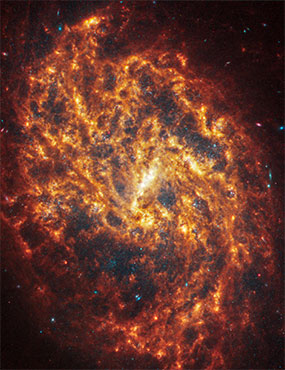 Extragalactic astronomy is the study of the Universe at distances beyond the limits of our Milky Way and its closest neighbours.
This includes the study of individual distant galaxies, to using those galaxies to trace the very structure and evolution of the Universe.
- Environmental regulation of supermassive black hole feedback across the cosmic web
- Galaxy evolution through dust and metal cycles
- Galaxy transformation during cluster assembly
- Gas, dust and metals in the Era of 4MOST: A Data-Driven Approach
- Measuring galaxy star formation rates
- The impact of environment on galaxies as probed by the SAMI and Hector Galaxy Surveys
- Understanding galaxies near and far with MUSE
- Unveiling the connections between gas, stars and star formation in nearby dwarf galaxies
Stellar and planetary astrophysics
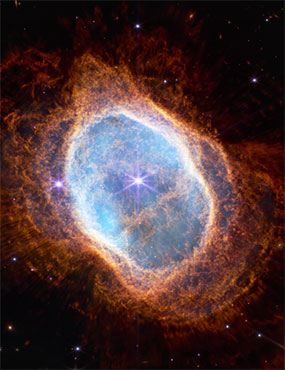 This theme includes:
- stellar structure and evolution, particularly in low and intermediate mass stars, binary interactions (see also theoretical and computation astrophysics)
- chemical evolution and origin of the elements
- clusters and populations (see also Milky Way and Local Group)
- galactic archaeology and galactic formation
- planet formation (see also theoretical and computation astrophysics)
- exoplanets detection (see also instrumentation and space technologies).
- Cosmic alchemy: Evolved stars as probes for stellar nucleosynthesis
- Finding Earth's neighbours with extremely precise radial velocities
- Imaging exoplanets with the James Webb Space Telescope
- Multi-wavelength high-angular-resolution imaging of second-generation planet-forming discs
- Stellar variability: Redefining the Milky Way’s fundamentals
- Using dying stars to reveal the origin of elemental isotopes in the universe
Milky Way and Local Group
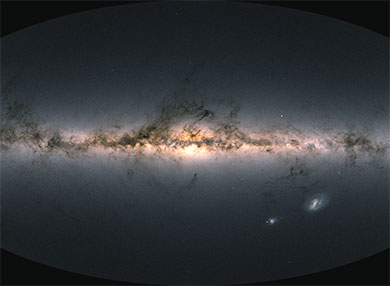 Our location in the Milky Way provides us with a unique vantage point to study the structure, composition and kinematics of our home galaxy, the Andromeda galaxy and other galaxies in our Local Group.
Astronomers at Macquarie University use imaging, spectroscopy and radio observations to understand the nature of our local environment.
Image by: BY-SA 3.0 IGO, A. Moitinho
- Forming the Milky Way inside out
- Galactic archaeology
- Modes of star formation across the Milky Way
- Satellites and stellar streams in the Local Group
- Stellar variability: Redefining the Milky Way's fundamentals
Interstellar medium
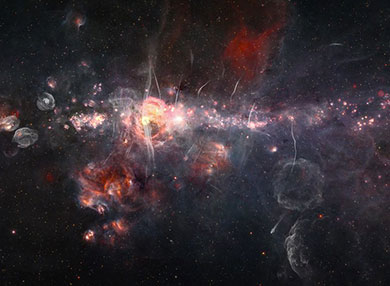 The interstellar medium (ISM) is the gas and dust between stars – the raw material from which stars form and to which they return when they die. The ISM responds to the energy and mass output by stars, in a complex feedback loop that shapes the lives of galaxies over cosmic time.
Image by: Judy Schmidt, Galactic Centre Infrared+Radio
- Revealing dust properties in distant environments
- The Australia Square Kilometre Array Pathfinder as a hydroxyl absorption machine
- Using pulsars to probe interstellar sheets and filaments at the Solar System scale
Theoretical and computational astrophysics
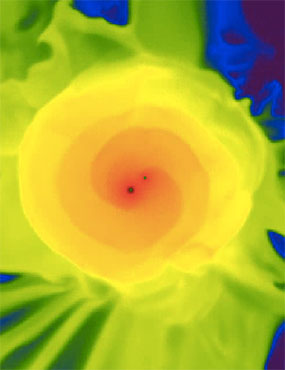 Theoretical and computational astrophysics research aims to generate models that can be tested with observations. Our group works on:
- models of stellar and binary star evolution
- planet formation
- galactic centre magnetic fields
- black holes.
The methodologies are analytical or semi-analytical models and 3D hydrodynamic simulations.
- Physical black holes: Role of the horizons
- Axially symmetric models
- Collapse and quantum effects
- Observable signatures of physical black holes
- Stellar collisions
- The structure and evolution of disks around evolved binary stars and its implications on binary evolution
Instrumentation and space technologies
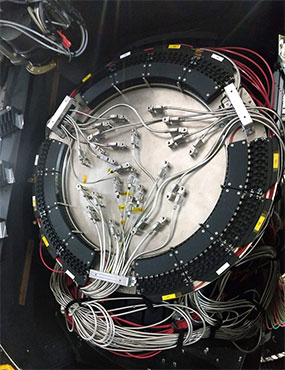 Our centre includes researchers at Australian Astronomical Optics – a recognised world leader in innovative scientific instrumentation, software and research, and a major node of the nationally funded Astralis Instrumentation Consortium.
Our researchers engage with major ground-based observatories, to deliver innovative instruments based on new technologies we are developing. These include:
- Novel spacecraft optical systems
- Astrophotonics
- Adaptive Optics for wide-field astronomical systems and high-resolution microscopy
- Make space safer with the Huntsman Telescope
- An ultra-stable infrared spectrograph to search for Earth-like planets
Data science/data intensive astronomy
 Our centre includes the Research Data Services group – part of Australian Astronomical Optics (AAO).
It specialises in creating applications to access diverse research data sets across multiple disciplines, and developing comprehensive data processing platforms for the complex instrument suites of major astronomical observatories.
- Galaxy classification by deep learning