
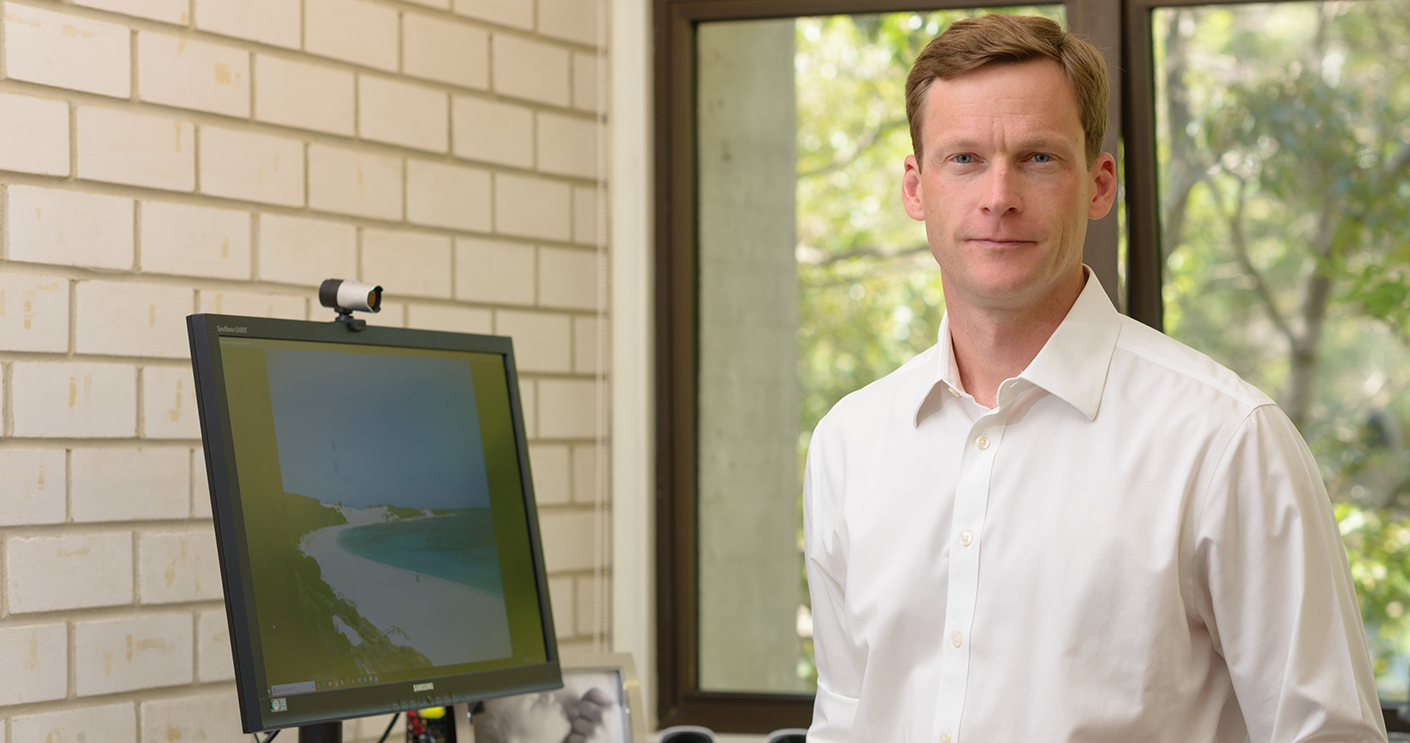
You can’t swing a … err… shark without hearing Nathan Hart’s name at the moment. In addition to being featured in Macquarie’s new advertising campaign, media outlets including the ABC and The Australian have been clamouring to talk to him about his shark-deterring technology.
We took a number and got a minute with the Associate Professor of Comparative Neurophysiology to find out more.
Tell us a bit about your background and what excites you about your field
I’ve spent most of my career studying how other animals see the world around them. It turns out that most animals see the world very differently from us humans. For example, most birds have four-dimensional colour vision and can see ultraviolet light, whereas sharks, whales and dolphins are completely colour blind. It is fascinating to try and understand how and why these differences have evolved.
Describe the nature of your research and the problem you are tackling
We’re spending a lot of time trying to find new and more effective shark deterrent devices. Fatal shark attacks are rare, and of course terrible, events but when they do happen they create a sense of fear that does not reflect the true risk. Unfortunately, this provides continued justification for shark population control measures such as meshing and drum lines, which kill both sharks and non-target animals such as turtles, dolphins, and stingrays. If we can develop shark deterrents that are effective and provide a greater sense of safety in the water, we can hopefully save the lives of people and our amazing marine megafauna.
What is the real-world impact of your work?
Over the last few years we have conducted independent testing on a range of shark deterrent devices that are currently available on the market. This provides consumers with a valuable source of information as to the efficacy of the products before purchase. Our new work on surfboards is aimed at protecting one of the highest risk groups of water users – surfers. We are testing ways of hiding or disguising the silhouette of surfers when viewed against the sky by a shark swimming below. This dark silhouette is probably one of the strongest sensory cues used by the shark to initiate an exploratory or predatory approach to a potential prey item. Although we have some work still to do on this project we hope to finalise a commercial prototype in the next 18 months to two years.
Tell us about the collaborations – both within the University and with external partners – that have been driving this project
The Department of Biological Sciences contains researchers with an impressive breadth of expertise in marine megafauna and this is an invaluable resource for interpreting the diverse shark behaviours we observe during our lab- and field-based research. Beyond the University, our shark deterrents work involves researchers from the University of Western Australia, Flinders University, Taronga Zoo, the NSW Department of Primary Industries, Oceans Research in South Africa, and commercial company Smart Marine Systems.
What is it about Macquarie that has allowed your research to flourish?
Macquarie is very supportive of innovation and has a lot of resources available to help researchers who want to take their science to the next level and turn it into real-world applications. The University has also been supportive in providing funding to improve aquatic research facilities on campus and continues to support the operation of the Sydney Institute of Marine Science.
 Back to homepage