Tour de Cure tour Macquarie cancer labs
Tour de Cure and Westpac’s Corporate Committee visit Macquarie University cancer labs to see the impact of Tour de Cure grants on cancer research.
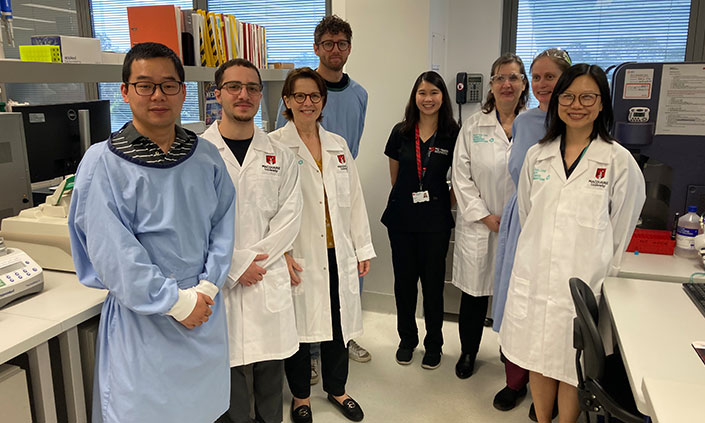
The tour, coordinated by Macquarie’s philanthropy team was a token of appreciation for the organisation's generous support of the University’s cancer research. The visit provided them a firsthand look at real-world impact of their funding through the university’s pioneering work in cancer research and advancing medical breakthroughs.
"It was great to have the Tour de Cure team visit our labs. We are incredibly grateful to their donors, whose generosity enables impactful research,” says Professor Helen Rizos.
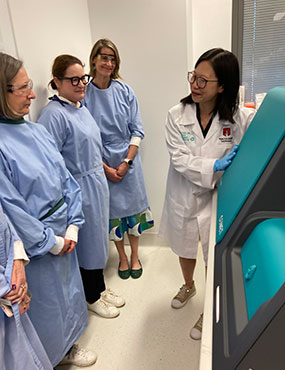
Researchers shared insights into how cutting-edge technologies and innovative approaches are shaping new frontiers in the fight against cancer. This included presentations from Esther Lim and Wei Yen Chan, whose research in Macquarie's Cancer Labs has been funded by Tour de Cure.
Key highlights included an explanation of functional precision oncology, including a demonstration of the Rastrum platform – a tool enabling researchers to design patient-specific models of cancer to inform, rather than dictate, treatment strategies.
“As part of the ACRF Centre for Advanced Cancer Modelling at Macquarie University, we are developing real-time patient cancer models to help select the best therapy for each patient and monitor responses,” adds Professor Rizos.
“We are also working towards a melanoma liquid biopsy assay to track patient responses throughout their treatment journey, bringing innovative approaches directly to the clinic.”
Attendees were introduced to the Cell Discoverer 7, an advanced 3D imaging microscope that captures how cancer cells grow and respond to treatments in real-time. The team also learned about the Cancer Biobank's role in advancing cancer diagnostics.
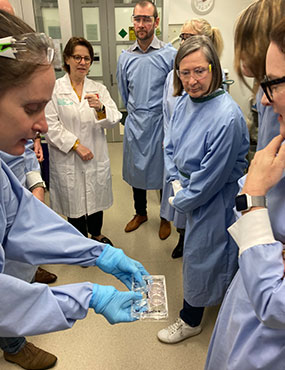
Researchers explained how they are using blood biopsies to detect cancer cells left behind after treatments for skin cancer, enabling the prediction of recurrence risks and the creation of personalised patient monitoring systems.
Another focal point was the Flow Cytometry facility, which provides critical data on tumour cell environments, immunological responses, and tumour cell behaviour in conditions like lung cancer, brain cancer and melanoma. Researchers also outlined innovative projects that involve testing therapies on patient-derived physical samples to create tailored avatars for personalised treatment approaches.
“This kind of meaningful behind-the-scenes experience is wonderful way to show our donors the impact of their support” says Manasi Kogekar, Senior Development Manager at Macquarie University.
“It shows how the partnership between Tour de Cure, Westpac and Macquarie University is driving real progress in cancer research and enabling patients with cancer to receive life-changing personalised treatments”
Contact us
Philanthropy
Level 2, 18 Wally's Walk
Macquarie University NSW 2109