How to lead when the future is uncertain?
On 29 July, Macquarie Business School hosted an insightful discussion on ‘Governance and the Technological Challenge’.
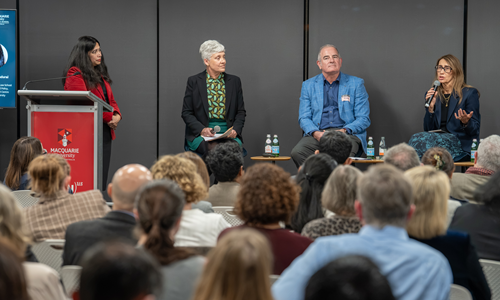
Professor Leonie Tickle, Executive Dean of Macquarie Business School, set the scene for the leadership series discussion, posing the question, “How can leaders make better decisions when the stakes are high, the risks are evolving and the future is uncertain?”
Over the course of the event a few themes emerged to answer this question.
Be aware of biases and blind spots
The evening’s keynote speaker, risk governance expert Professor Elizabeth Sheedy, suggested leaders should be aware of their biases and blind spots when facing challenges.
Professor Sheedy said, “Risk management is fundamentally difficult. It's not something that comes naturally to humans because of certain biases and incentive conflicts that get in the way.”
Some common biases are optimism, groupthink, short-termism and availability. And Sheedy says that incentive conflicts come in many forms, not just poorly designed remuneration systems.
Using examples of rapid technological change in recent years, Professor Sheedy demonstrated that when proper risk governance is in place, uncertainty can turn into world-changing innovation.
“On farms around the country, robots weed crops, AI-controlled lasers are patrolling fields, and pigs are wearing Fitbits,” Professor Sheedy said.
“Using these methods, the amount of herbicide is being reduced by more than 90 per cent. The ear tags on the pigs mean that farmers can identify which pig is sick, treat it quickly, and remove it from the rest of the herd before it spreads. So, these technologies offer the potential for massive improvement in farm productivity, and this is going to be so crucial to feed our world as the population peaks at probably about 10 billion later on this century.”
Good governance starts with education
Avoiding biases and blind spots can be tricky if you are working alone. Professor Sheedy explained that the educational backgrounds of directors matter more than you may think when it comes to being comfortable with new technologies.
“Having at least one director with a master's degree or higher, or a STEM background, significantly increases AI engagement,” she said.
“This suggests that AI engagement is driven primarily by technical and analytically oriented governance capabilities, rather than by general management credentials.”
Board diversity of knowledge and backgrounds allows businesses to watch out for the longer-term strategic risks and adapt as needed. Directors must be actively involved in decisions about strategy and risk appetite, challenging the executive and ensuring that effective risk frameworks are operating.
Manage risks with good control frameworks
During a panel discussion that explored the adoption of artificial intelligence by companies and countries, Richard Kimber, Chair of Lumi Financial Holdings and Non-Executive Director at ING Bank Australia, said, “To embrace AI is a journey, and to get on that journey, you need to start somewhere.”
The panel agreed that Australia has some catching up to do in terms of AI adoption and can look to other countries who are more advanced for inspiration.
“We need to take a leaf out of the book of countries that are advancing quicker than us, like the UK, which has a 50-point National AI plan and have executed 38 of the points already,” said Kimber.
For those who are nervous about the risks of new technologies, Renée Roberts, Chief Risk Officer at Judo Bank and former Executive Director of Banking at the Australian Prudential Regulation Authority (APRA), said boards already have experience of managing risks in their industries.
“You can go through all the material risk types that you will see in any financial services risk management strategy document – credit risk, market risk, operational risk, legal risk, contract risk – and I would say that AI risk is embedded in all of those,” said Roberts.
She explained that with the right control frameworks, those risks can remain under control, and new technology can bring great benefits to your business.
Senior executives need to be accountable
Speaking as a lawyer and the panel moderator, Professor Niloufer Selvadurai from Macquarie University’s Applied AI Research Centre, raised a significant point around liability and accountability.
“One of the big things with AI is that we don't have a clear roadmap of liability,” said Professor Selvadurai, as she opened up the discussion to the panel.
Professor Sheedy explained the operator accountability model.
“What I’ve learned about governance in the last few years is, just as you can’t outsource accountability to a technology, you actually can’t outsource accountability to any junior staff member. Really, the accountability sits at the top,” said Professor Sheedy.
“Where organisations have gone wrong is that the people at the top are just not doing their jobs, frankly. People hide behind group decision-making processes. They hide behind ignorance.”
The principle of “You can delegate responsibility; you cannot delegate accountability” applies to AI and should guide how we interact and evolve with these new technologies.
Watch the full event below.