Graduate talent in the age of AI
Employers say adaptability, curiosity and good judgement will be more valuable than ever in a world of Artificial Intelligence (AI).
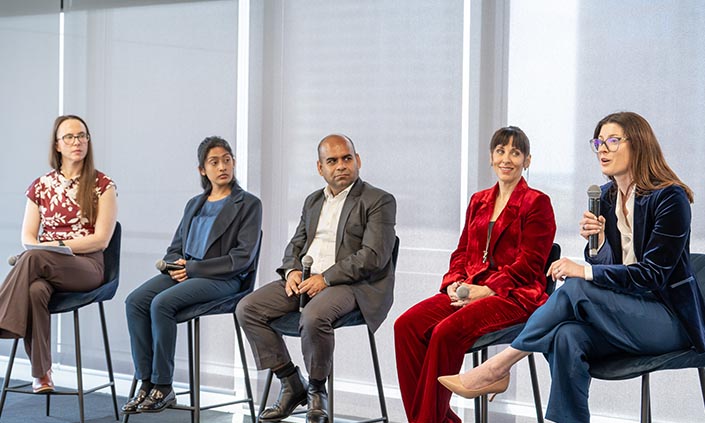
AI is reshaping workplaces across all industries. But despite predictions that AI will replace our jobs, former Higher Education Industry Executive for Microsoft Australia & New Zealand, Katie Ford, argues that graduates remain critical to the future workforce, even as traditional career pathways evolve.
Drawing on her interviews with professionals who are leading the way with AI adoption and integration, Ford shared key insights about what companies want from their graduate recruits at Macquarie Business School’s Employability Summit on 7 October.
Employers want critical thinkers, not passive users
One of Ford’s main findings is that employers increasingly want graduates who can work effectively with AI, not just use it.
"I've been hearing this since 2024: 'We are hiring people with AI skills,'" Ford said.
But AI skills are not simply about writing prompts. Employers said they want people who understand when AI should and should not be used, who can challenge its outputs and identify bias or gaps in the information it provides. They are looking for critical thinkers, not passive users.
Adaptability remains highly sought after
Ford’s conversations also revealed that employers continue to place a premium on human capabilities. One quality surfaced repeatedly: adaptability.
"The human skills do come up, but the one that kept on coming up again and again was the adaptability issue," she said.
She described this as an "adaptability quotient" or AQ, the ability to learn, change course and thrive in uncertain environments. No one can predict exactly how professions will evolve as AI advances, so hiring people who can navigate change is becoming increasingly important.
Traditional graduate jobs are being redesigned
One thing that is changing rapidly is the kinds of tasks graduates have traditionally performed. The routine work that once helped young professionals learn the basics of a job, such as document review, research and administrative analysis, can now often be completed by AI.
This shift is creating difficult questions for employers. If AI takes over many entry-level tasks, how do organisations develop the next generation of experts and leaders?
"We have these bright people,” Ford said. “We have a vested interest to all of us in creating graduates who will rise to become senior professionals, who will be the future leaders of these organisations. How do we do that?"
Some organisations are reducing graduate intakes and becoming more selective, while others are redesigning graduate roles altogether, Ford explained. But she cautioned against concluding that graduates are no longer needed.
Organisations and graduates can meet halfway
"My request to employers in the room is do keep the door open to graduates,” Ford said.
Organisations should rethink early-career development and create new forms of preparation that help graduates build professional judgement while working alongside AI.
For students, the message is equally clear. Qualifications still matter, but employers increasingly want evidence of what graduates can actually do beyond their academic transcript. Ford heard repeatedly that organisations want candidates who can demonstrate projects, creations and practical outcomes, whether developed at university, work or in their own time through clubs and societies.
AI is undoubtedly changing work, but it is also creating new opportunities. The Employability Summit at Macquarie Business School provided the perfect forum for leaders in industry and education to share leading thinking on career readiness in an era of disruption and possibility, and practical ideas for building future-ready learners and graduates.
Samantha Wilson, the General Manager of Chartered Accountants Australia and New Zealand, attended the forum and valued the insights from different industries.
“The session provided a wonderful opportunity for educators, employers and students to come together and for each perspective to be heard and considered as we discussed the risks and opportunities in the age of AI,” Wilson said.
“My key takeaway was that mentoring colleagues, developing talent and shaping culture remain uniquely human contributions, which is why AI adoption must be a workforce and people conversation, not just a technology decision.”
Watch the highlights