Behavioural science is changing economic policy
Small interventions designed to influence behaviour are now transforming public policy, governance and decision making.
From encouraging people to pay overdue taxes to promoting healthier lifestyles, behavioural science has been applied worldwide to drive measurable change. But Professor David Halpern CBE, a global leader in the field and former head of the United Kingdom’s Behavioural Insights Team (BIT), believes this is only the beginning.
Speaking at Macquarie Business School’s Leadership Series, Halpern delivered a keynote exploring how behavioural science can evolve beyond nudges to enable systemic, long-term impact. Drawing on decades of experience applying behavioural insights to real-world policy, he outlined how a deeper understanding of human behaviour can address challenges in government, business and technology.
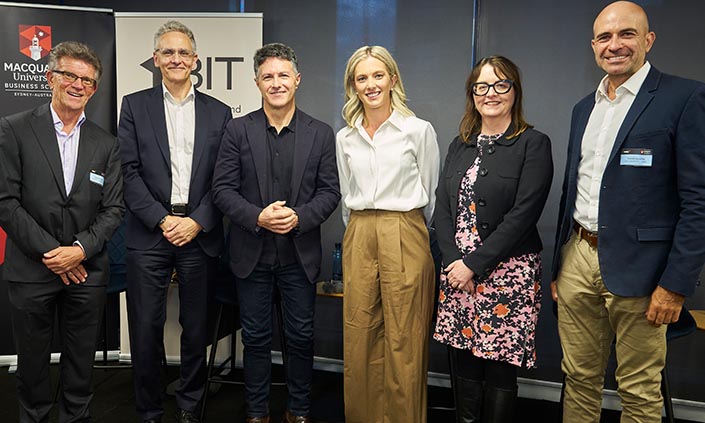
The evening began with a live behavioural experiment demonstrating how decision-making biases, including present bias and the sunk cost fallacy, affect reasoning. Halpern was joined by a panel featuring former NSW Minister The Hon. Victor Dominello, Dr Juliette Tobias-Webb, Maroš Servátka, and moderator by Professor David Orsmond.
In his address, Halpern highlighted how behavioural research has challenged long-held assumptions about rational decision-making. “Policymaking has long been driven by the presumption that people make decisions through logical, deliberative processes,” he said. “But research continues to show that much of our behaviour is influenced by automatic, fast-thinking processes that are riddled with cognitive biases.”
Citing the success of BIT’s 2000 projects across 81 countries, Halpern shared practical examples of nudges with real-world impact. Simplifying government notices has increased tax compliance. Reframing parking fines has improved payment rates. These low-cost adjustments have delivered significant behavioural shifts at scale.
While acknowledging the success of nudging, Halpern argued that the next phase lies in “boosting”. Rather than relying on singular, context-bound interventions, boosting focuses on equipping individuals with skills and structures that strengthen their decision-making over time.
“The tools of behavioural insights have fundamentally reshaped public policy,” Halpern said. “However, we have barely scratched the surface of their potential. The goal now is not just to nudge individuals, but to create structures that empower them to make better decisions themselves.”
The panel discussion expanded on how behavioural insights can shape digital services, public policy and leadership practice. Victor Dominello reflected on how behavioural science informed citizen-first digital reforms during his time as NSW Minister for Customer Service.
The event underscored the growing influence of behavioural science as a driver of societal change, offering practical strategies for applying both nudges and boosts across sectors. Through its Leadership Series, Macquarie Business School continues to bring global thought leaders to campus, highlighting the transformative potential of behavioural insights in shaping economic and social policy.