Five minutes with... Rachael Dudaniec
It is National Science Week, making it an opportunity to celebrate the thrill of exploration and the brilliant people who make science happen.
Contact us
12 Wally's Walk
Balaclava Rd, North Ryde, Macquarie University
NSW 2109 Australia
This week is National Science Week, making it a wonderful opportunity to celebrate the thrill of exploration and the brilliant people who make science happen. The theme for this year is "Seeds of science: Nurturing knowledge for all", and it invites us to think about how curiosity blossoms into discovery and how knowledge is shared so that it can benefit everyone.
Associate Professor Rachael Dudaniec, ARC Future Fellow, School of Natural Sciences, Director, MQ Pollinator Futures Research Centre, discusses her passion for understanding the natural world and her recent expedition to Antarctica where it all came to life.
1) Why do you celebrate National Science Week?
Science is humanity's most powerful tool for understanding the world.
As a researcher, I find it very motivating that, even in a small way, my work can contribute to our understanding of the natural world and help to address real-world challenges.
I think that science is the most effective way to advance knowledge that supports biodiversity conservation, strengthen biosecurity, and help us to manage and understand species responses to environmental change.
2) This year's theme for National Science Week is 'Seeds of science: Nurturing knowledge for all'. Can you share what this means for you?
This theme makes me reflect on the need for science to be accessible to all, to learn, to use, and to contribute to. It invokes a sense that scientific knowledge starts from people, and it can start from very small steps of enquiry leading to deeper understanding. ‘Nurturing knowledge for all’ reminds us that investing in science is for the benefit of all people, and it is something that requires consistent effort and intention.
3) You recently went on an adventure. What is the Homeward Bound leadership program?
Homeward Bound is a 12-month online leadership development program for women and non-binary people with backgrounds in STEMM (Science, Technology, Engineering, Mathematics and Medicine).
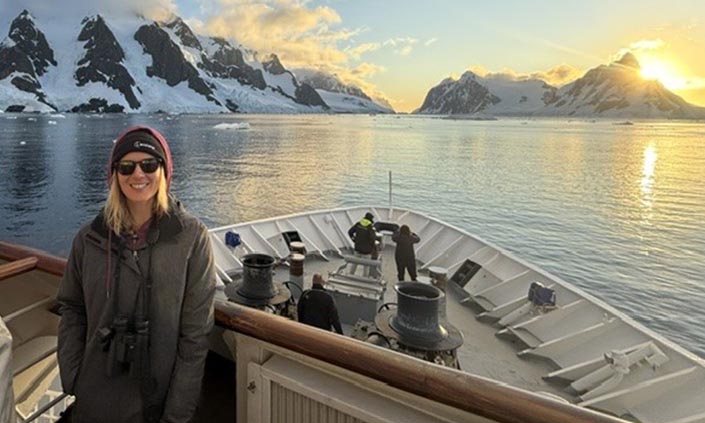
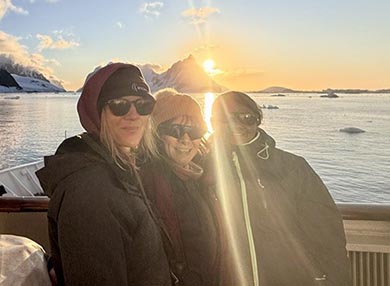
Following this, there was a two-week expedition to Antarctica with almost 100 other women and non-binary people in STEMM, from all over the world. This trip was supported by Macquarie University, which enabled me and two other Macquarie researchers (Nuwanthika Fernando and Rebecca Brown from Australian Astronomical Optics, FSE) to attend. Antarctica was a powerful setting to not only learn about Antarctic science and see the effects of climate change in front of your eyes, but it was also an immersive experience that built collaborative and supportive networks.
4) Can you describe the moment you first arrived in Antarctica?
To get to Antarctica, we had to fly to the most southern city in the whole world – Ushuaia in Argentina – aboard a ship and then cross the famously treacherous Drake Passage for two nights, which felt like being in a washing machine. Then, the first sign we had arrived in Antarctica was the sight of giant ice monoliths passing us by as we slowly navigated the calm waters of the upper Antarctic Peninsula. The icebergs, each very different in form, were like breathtaking sculptures. Some were 50 metres high and reflected an intense blue in the sunlight. Seeing the first icebergs was the first time it hit home that we had arrived.
5) Was there a moment or a person on the expedition that completely changed your perspective?
One day, it was a beautiful, clear blue sky, and we were anchored in a calm bay. I was at the back of the ship when I saw the fin of a humpback whale approaching the ship. This huge whale proceeded to come right up to the ship and curiously traverse the length of the boat, looking up at us intentionally and breaching out of the water just a few metres from the ship.
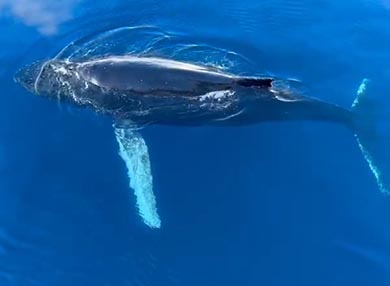
The whale stayed with us for over half an hour, swimming under the ship from one side to the other, as 100 of us all shuffled from port to starboard with our cameras in amazement. Each person on the boat felt a connection with this whale on that day – a true mammalian ancestral moment!
This moment was one of truly appreciating the visual landscape of Antarctica, but also the ecosystem that sustains it, the fragility of the animals and the climate that it relies on.
6) What did you learn about leadership in science?
Being able to perform experiments and conduct protocols is one aspect of being a scientist, but communicating science, teaching science and working collaboratively is just as, if not more, important. The ability to lead multi-disciplinary teams with different levels of expertise and knowledge towards a common goal is the work of scientists. Being able to lead others in ways that are inclusive and empowering to all involved enables research ideas to be freely developed and to be challenged constructively. Effective leadership is important for enabling others to succeed and to ensure research has meaningful impact beyond academia.
7) Why is it so important for women and non-binary people in STEMM to be supported through initiatives like this?
Women and non-binary people in STEMM fields remain underrepresented in senior leadership positions. That means we risk losing valuable perspectives, expertise, and potential. Science benefits from diversity in that more diverse teams are more likely to challenge assumptions and be more creative in tackling complex problems. Leadership initiatives like Homeward Bound help to equip emerging leaders with the skills and networks needed to influence STEMM fields to make meaningful impacts.
8) What advice would you give to young women considering a career in science?
Persistence and resilience are just as important as intelligence. Stay curious and do not underestimate your potential. And if it is challenged, say yes to more challenges that push you out of your comfort zone. Seek out trusted mentors and collaborators who will support you and want to see you succeed.
9) How does your research support the MQ Pollinator Futures Research Centre?
I study bee health and evolution using multiple genomic sequencing approaches. My research examines how bees and their pathogens spread and evolve across diverse environments. We are dependent on native and introduced bee pollinators for our food security and biodiversity, so understanding the factors that govern their health and persistence is essential for managing them under persistent threats from climate change, pathogen invasions and habitat loss. My research therefore strives to inform more sustainable approaches to pollinator and biodiversity management.
10) Who are you outside of the lab?
When I'm not at work, I enjoy staying active through yoga and exercise, spending time with friends and family, and spending time in nature. I've found that when one area of my life is neglected, it affects the others, so maintaining work-life balance is something I prioritise. I also have a real passion for travel, learning languages, and experiencing different cultures, as I enjoy understanding different perspectives and ways of thinking.
Rachael and the participants on the trip to Antarctica completed a collaborative artwork called ‘Postcards from Antarctica’. You can visit the exhibition this National Science Week.