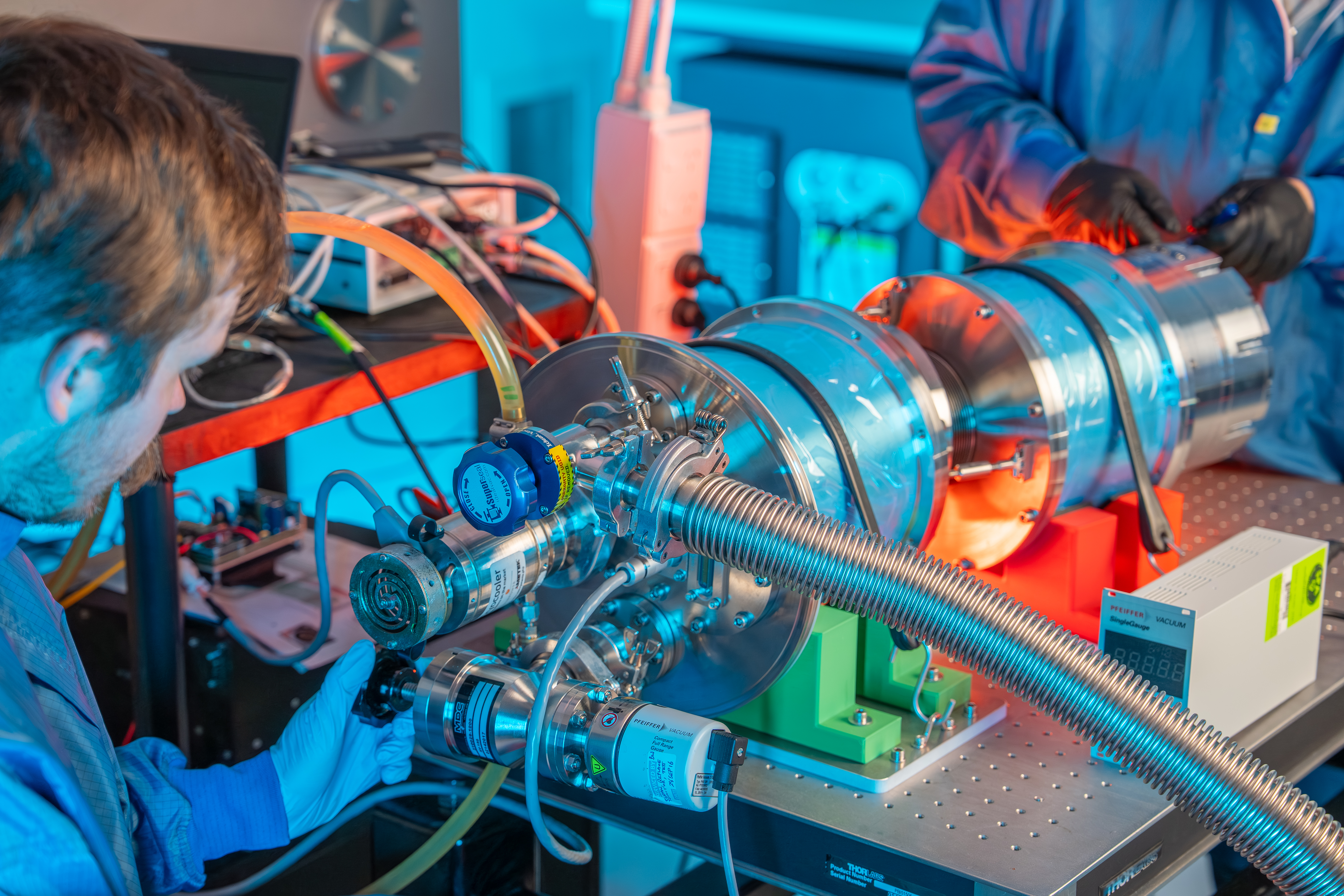
Australian Astronomical Optics at Macquarie University is one of the world's leading instrumentation groups, with over 50 years of heritage in building advanced instruments for the largest telescopes on Earth and in space.
AAO
9 Wally's Walk
Macquarie University NSW 2109
AAO welcomes postgraduate students to join our team of more than 50 engineers and scientists working on live projects - from adaptive optics systems for 8-metre telescopes to photonic devices and satellite payloads -gaining hands-on experience that no other graduate programme can match!
Prof Richard McDermid, AAO Director
Engage in research projects related to MAVIS (MCAO Assisted Visible Imager and Spectrograph) - a next-generation visible-light adaptive optics instrument for ESO’s Very Large Telescope (VLT) delivering diffraction-limited imaging and integral-field spectroscopy. Depending on the candidate’s interests and background, projects may include one or more of the following:
Supervisor: Richard McDermid
High-precision robots operate with micron- and nanometer-scale accuracy through ultra-stiff mechanics, laser metrology, high-resolution encoders, and advanced feedback control. This project focuses on precision positioning technologies for astronomical instrumentation, while addressing wider applications including micro-assembly, optical alignment, semiconductor handling, and biomedical procedures. Research areas include calibration and modelling, vibration and thermal compensation, sensor fusion using vision and laser feedback, and precision control algorithms. HDR projects involve designing novel parallel or hybrid manipulators, developing visual-servo alignment systems, and building micro-positioning prototypes for tasks requiring ultra-precise positioning and stability in challenging operating environments.
Hyperspectral imaging is an emerging healthcare technology that captures hundreds of wavelength bands beyond standard RGB imaging, enabling visualization of tissue oxygenation, perfusion, hemoglobin, and water content through false-colour maps. This project will develop a miniaturized hyperspectral endoscopic imaging system for real-time, label-free tissue assessment during surgery, drawing on advanced optical concepts from astronomical instrumentation. The work will include imaging hardware design, calibration methods robust to surgical conditions, and AI-based spectral analysis for tissue characterization. Validation using tissue phantoms and clinical datasets will evaluate feasibility for real-time surgical guidance, supporting improved identification of abnormal tissue while reducing reliance on invasive biopsies.
This project explores AI-assisted design methodologies for precision optical and mechanical systems, aiming to accelerate development while maintaining design traceability. The research will investigate optical and mechanical architecture exploration, reuse of prior design knowledge and components, surrogate modelling for rapid optimisation, and fabrication-aware generative and topology design. Additional focus areas include manufacturability, alignment tolerances, inspectability, and supply-chain considerations during early-stage development. Candidate tools include Zemax OpticStudio for optical modelling, ANSYS for structural and thermal simulation, and Autodesk Inventor for mechanical design and integration. Applications include telescope instrumentation, opto-mechanical assemblies, and precision alignment systems for high-performance engineering environments.
Supervisor: Jon Lawrence
What if a single satellite could track a bushfire as it ignites, then swing across the continent to check the health of a freshwater lake, all in one pass? At Australian Astronomical Optics (AAO), we are applying precision optical engineering to the next generation of Earth observation, with payloads spanning fire-prone vegetation monitoring to harmful algal bloom detection. A flagship example is the Omnidirectional Wide-angle Locator (OWL), a novel linkage-driven steering mirror that rapidly redirects a telescope's line of sight across a wide field of regard. HDR projects span mission simulation, custom optical design, and space qualification.
Every functioning society now depends on satellites for navigation, communications, weather, finance, and defence. At AAO, we build the telescopes, sensors, and software to identify, track, and characterise objects in increasingly crowded orbits. The Huntsman Telescope at Siding Spring uses ten co-aligned lenses to scan the geostationary belt, while our new Orbweaver facility at Macquarie pushes multi-spectral satellite observations into the daytime. HDR projects include rapid satellite identification, daytime characterisation, faint-object imaging in cis-lunar and X-GEO regimes, and automation for responsive observing.
On 13 April 2029, asteroid 99942 Apophis will pass closer to Earth than our geostationary satellites. AAO is developing a novel hyperspectral imaging spectrometer to fly to GEO and capture material composition and thermal data during this once-in-7,500-year encounter. Partnering with HEO, we are using new sensor technologies, all-aluminium aspheric optics, and athermal design, opening the door to sovereign Australian deep-space imaging. HDR projects span thermal design, aluminium aspheric optics, hyperspectral calibration and spectral retrieval, and flyby imaging strategy for a high-velocity encounter.
Supervisor: Lee Spitler
Photonic technologies have the potential to transform astronomical instruments through miniaturisation, stability and new functionalities impossible with traditional optics.
Research directions:
Supervisor: Simon Ellis
The Subaru Telescope's ULTIMATE instrument will correct atmospheric turbulence across an unprecedentedly wide field of view — transforming how we survey the night sky. But how do you measure the performance of something so vast and complex? This PhD project will develop cutting-edge point spread function (PSF) estimation tools to characterise ULTIMATE's adaptive optics performance across the full field, turning raw telescope data into scientifically reliable images. You'll work at the intersection of atmospheric physics, optical modelling, and astronomical data science, contributing directly to one of the most ambitious ground-based astronomy projects of the decade.
Every ground-based telescope battles the same invisible enemy: atmospheric turbulence that blurs starlight before it arrives. Understanding how light waves propagate through turbulence in real time is the key to correcting it. This PhD project will develop physical models linking measurable atmospheric variables — temperature, humidity, pressure — to turbulence parameters, enabling smarter, faster adaptive optics compensation. Grounded in Kolmogorov turbulence theory and validated through field measurements, your work will push the boundaries of how observatories characterise and respond to the ever-changing atmosphere above them.
Looking deep into biological tissue is surprisingly similar to peering through the atmosphere — light scatters and distorts, obscuring the details you need to see. Adaptive optics, long used in astronomy to sharpen telescope images, is now revolutionising microscopy. This PhD project will advance a novel MOAO-based (Multi-Object Adaptive Optics) microscope capable of imaging deep tissue across a wide field simultaneously — a major leap beyond current technology. You'll combine optical engineering, wavefront sensing, and biomedical imaging, with your discoveries potentially opening new windows into neuroscience, cancer biology, and beyond.
Supervisor: Dani Guzman
We encourage you to contact a potential supervisor first to discuss your interests and available project opportunities.
After discussing a project, submit your formal application through Macquarie University. For more information about research areas, click here.