AAO conducts world-leading research across five instrument science areas, combining photonic innovation, precision engineering, and cutting-edge software to push the boundaries of what telescopes can observe.
AAO
9 Wally's Walk
Macquarie University NSW 2109
Astrophotonics applies cutting-edge photonic devices to astronomical instrumentation. Our group pioneers OH suppression using fibre Bragg gratings — the technology that enabled the world's first astrophotonics instruments, GNOSIS and PRAXIS. We also develop silicon photonics for astronomy, ring resonators, and photonic lanterns. Prof. Ellis authored the first-ever textbook on astrophotonics.
Contact: Prof. Simon Ellis
Our group designs and builds multi-object and integral-field fibre spectrographs for the world's premier observatories. We are pioneers of multi-object spectroscopy with instruments such as HERMES, GHOST, and BlueMUSE, and we contribute to next-generation facilities including the Widefield Spectroscopic Telescope (WST). We develop innovative fibre-positioning technologies — including Starbug robots and the Echidna positioner — that enable simultaneous observations of thousands of targets.
Contact: Prof. Jon Lawrence
Our space instrumentation research extends AAO's half-century of optomechanical expertise to remote sensing from satellite-based platforms. We develop precision optical payloads for Earth-observation and space science missions, including thermal cameras and agile tracking systems. Our projects including the Malya thermal camera (delivered to Gilmour Space Technologies) and the LUNA lunar laser collimator with Advanced Navigation for the Australian Space Agency's Moon to Mars initiative.
Contact: A/Prof. Lee Spitler, Prof. Mark Casali
Watching the sky day and night, Australian Astronomical Optics at Macquarie is developing advanced telescopes, multi-sensor instrumentation (e.g., Huntsman), and intelligent software systems to rapidly detect, track, and characterise satellites and other space objects across crowded orbits. From daytime multi-spectral observations to faint-object regimes out to the Moon, we are developing new technologies and training the next generation of researchers to deliver responsive, real-world space domain awareness capability.
Contact: A/Prof. Lee Spitler,
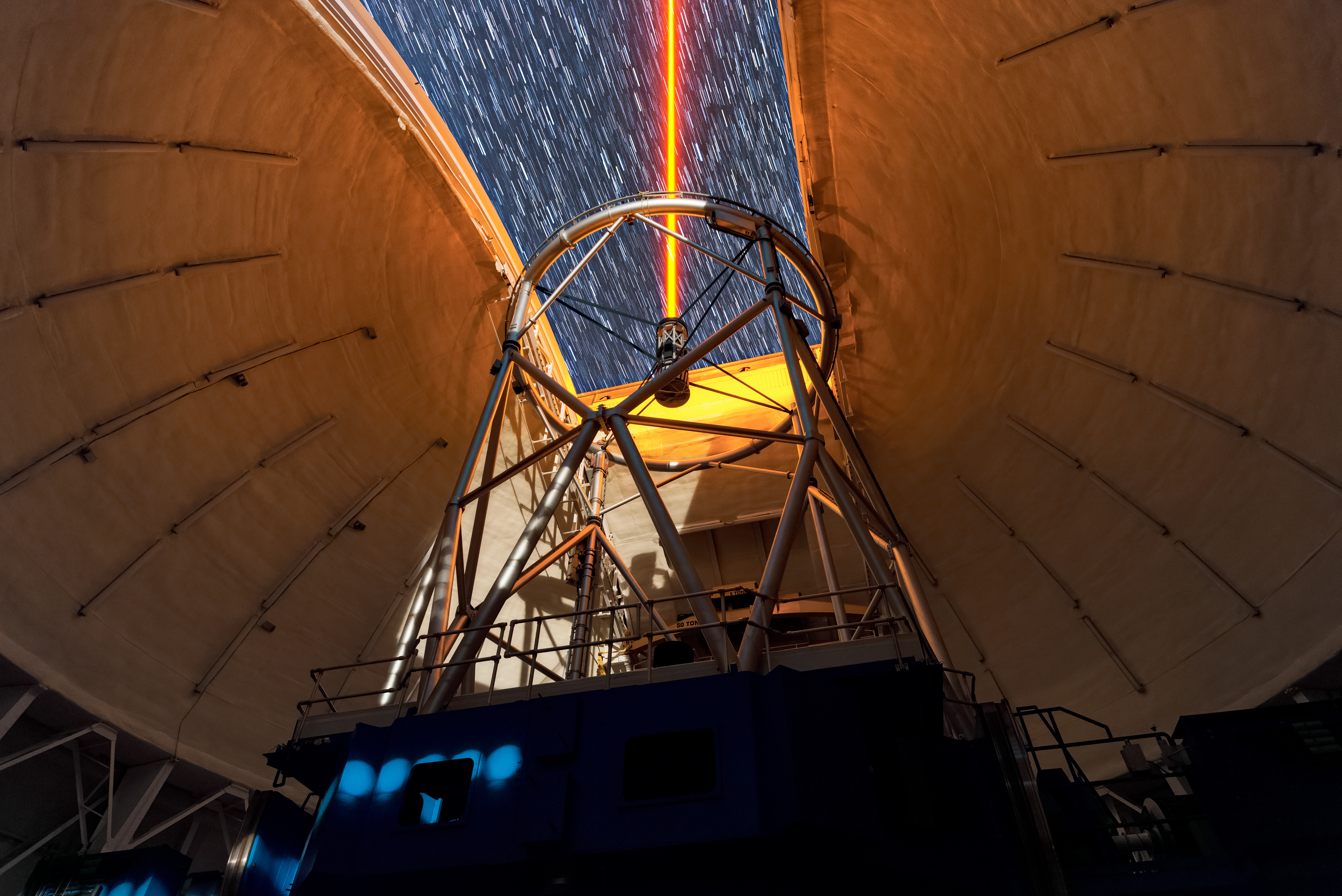
Adaptive optics (AO) corrects for atmospheric turbulence in real time, allowing ground-based telescopes to achieve near-space-quality resolution. AAO leads the international consortium building the Gemini North Adaptive Optics Bench (GNAOB) — a transformative A$15M upgrade for the 8m Gemini North telescope in Hawaii, which passed Critical Design Review in May 2026. We also lead the imager design for MAVIS, the world's first visible-band multi-conjugate AO system for ESO's Very Large Telescope.
Contact: Prof. Richard McDermid, Prof. Jon Lawrence, Dr. Dani Guzman
We translate the precision photonic and optomechanical engineering developed for astronomical instruments into devices for medical and biomedical applications. This includes miniaturised fibre-optic probes and precision optical systems for clinical diagnostics. This research exemplifies AAO's broader mission to apply world-leading instrumentation expertise across domains beyond astronomy.
Contact: Dr. Dani Guzman, Prof. Jon Lawrence