Contact us
12 Wally's Walk
Macquarie University
NSW 2109 Australia
Purposefully driven, innovative, globally impactful
The Faculty of Science and Engineering is a young and dynamic faculty driven by the spirit of discovery. Here we nurture the next generation of science and technology innovators.
From a handful of students on the University’s first day, the faculty now serves 6500 students across all our programs.
Our research and teaching addresses the big issues faced by society in Australia and globally:
- artificial intelligence
- accelerating climate impacts
- translating bioinnovation
- addressing nationwide skills shortages in engineering and computing.
The pairing of engineering and science in a single faculty means many of our research discoveries in science see direct technological applications in engineering.
Our research excellence
The Faculty of Science and Engineering includes many research centres and groups, and is home to over half of Macquarie University’s Centres of Research Excellence.
We are active in many industry partnerships, commercial collaborations and joint enterprise initiatives with government, industry and business partners.
Our schools and departments
The faculty consists of:
- four schools:
- Computing
- Engineering
- Mathematical and Physical Sciences
- Natural Sciences.
- two research departments:
- Applied BioSciences
- Australian Astronomical Optics.
Our passionate staff and engaged coursework and graduate research students are dedicated to the advancement of science and engineering in the 21st century. View our schools and departments.
Graduate research degrees
We supervise and progress graduate research students undertaking their research masters and PhDs across a wide range of specialist discipline areas.
We provide research training pathways for students from Australia and around the globe.
Our foundations and future
The strength of our faculty lies in our people: the students, educators, researchers and partners who turn ideas into impact. As Executive Dean, it gives me great pleasure to introduce the new 2026–2030 Faculty of Science and Engineering Strategy.
Professor Samuel Muller
Faculty Executive Dean
Through a process of extensive consultation, our strategy has been designed to translate Macquarie University's ambitions into focused actions across science and engineering.
Our vision is clear: to be a globally impactful, innovative and resilient faculty of science and engineering, purposefully driven by quality and productivity, with strong and sustained connections to national and local industry.
We pursue this vision at a moment of profound change – and real opportunity.
Artificial intelligence is reshaping society – transforming how we discover knowledge, how we teach and how we work together – presenting the challenge of harnessing its efficiency while preserving the foundational skills that underpin deep expertise.
Accelerating climate impacts and continued biodiversity decline are among the defining challenges of our time. The window to meet agreed climate and conservation targets is narrowing. This makes rigorous, trustworthy science more important than ever.
Breakthroughs in genomics, AI-enabled diagnostics and biomedical engineering, set against heightened global health demands, make this a critical moment for translating bioinnovation into real-world impact. Surging growth in computing and engineering has created nationwide skills shortages that we want to meet through a distinctive, industry- and society-relevant curriculum that produces work-ready graduates.
We are uniquely positioned to respond: with the Macquarie Park Innovation District at our doorstep, we have an extraordinary proximity advantage for partnership and translation. We will build deeper connections locally and nationally and leverage our international networks fully to maximise our impact and reputation.
Moreover, the case for fundamental science has never been stronger. Even as funding schemes increasingly favour applied and industry-led research, and government investment in universities declines, fundamental science remains the wellspring of knowledge discovery and step-change innovation. It remains central to our identity and we will grow it thoughtfully.
In a time of uncertainty, we will not retreat into caution: we will be more adaptable in how we solve complex challenges, more deliberate in where we focus our resources and more ambitious in the opportunities we pursue.
This strategy commits us to invest where we can achieve genuine distinction. In the fundamental and applied sciences, we will pursue excellence with conviction. In engineering and computing, we intend to be among the top universities nationally in the areas where we can build enduring scale. Across all disciplines, we will champion the highest standards of integrity and ensure our graduates remain the graduates of choice.
We will also change the way we work: We will create an enduring partnership with our high-performing community, enabling their success and supporting each and every member to lead from where they are as they aspire to a better future. I warmly invite our colleagues, students, partners and community to join us.
The opportunities before us are significant. We will pursue them with clarity, with purpose and with confidence, building a faculty whose impact endures well beyond this strategy and the decade ahead.
Professor Samuel Muller
Executive Dean
Faculty of Science and Engineering
Download the Faculty of Science and Engineering Strategy 2026-2030.
The Faculty of Science and Engineering traces its roots back to the founding of the University in 1964. The faculty came into being following amalgamation of the early Divisions of Environmental and Life Sciences and Information and Communication Sciences in 2009.
The appointment of key figures within these two divisions has informed our approach and strategy to this day:
- Professor Frank Mercer appointed as the Chair of Biology in 1965
- Professor John Ward, a Fellow of the Royal Society and nominated for a Nobel Prize twice, appointed to the University
- Professor Ron Aitchison became the first Professor in Electronics in 1971
- Professor Alan Voisey, the first Head of the School of Earth Sciences (and foundation Professor), who had been the foundation professor of Geology at the University of New England before coming to Macquarie
- Professor Jim Piper, who developed our world-renown capability in photonics
Over its formative years, the faculty led many significant initiatives including pioneering climate change research, the commercialisation of WiFi, photonics, evolutionary biology, and internationally leading research in Earth's crustal systems.
The School of Engineering was established more than a decade ago to focus on research and education in electronics, and has since expanded to other fields of engineering, ranging from civil and construction through to renewable energy engineering.
The faculty welcomed long-established astronomical instrumentation arm, Australian Astronomical Optics (AAO) in 2019.
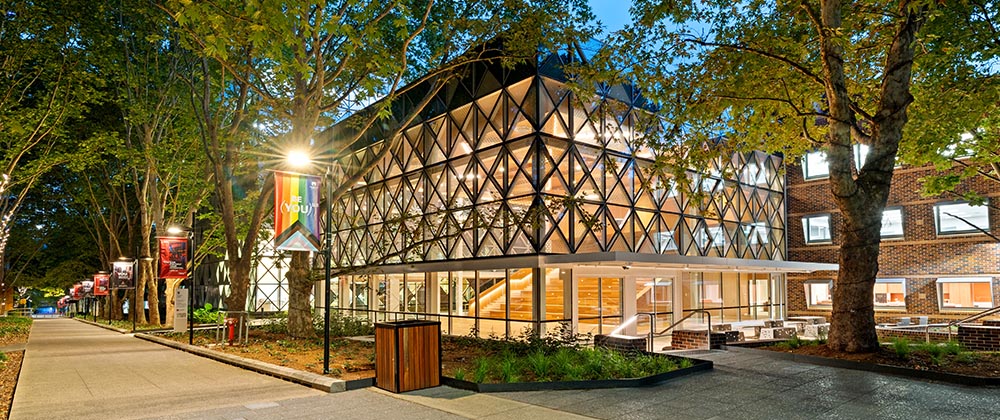
Originally located off-site, Engineering and AAO were brought together on Wallumattagal campus in 2025. Our newest, purpose-built, engineering and innovation building offers unique facilities supporting the development of cutting-edge astronomical instrumentation, and distinctive engineering education programs.
The Faculty of Science and Engineering provides a wide range of services and instrumentation for research and commercial projects through its Macquarie Analytical and Fabrication Facility (MAFF). The facility offers cutting-edge services, including:
- material characterisation and analysis
- microscopy
- nuclear magnetic resonance analysis
- proteome analysis
- technical design and manufacture.
Learn more about the diverse offerings available through MAFF.