10 Questions with ... Vincent Hurley
Dr Vincent Hurley shares how his journey from policing to academia shaped his approach to preventing gender-based violence in the next generation.
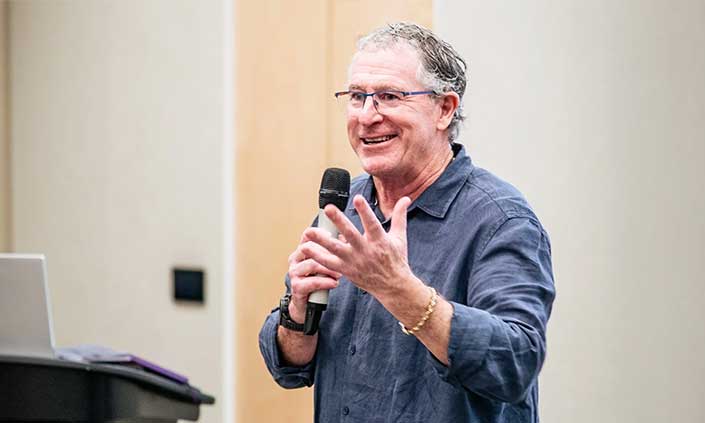
With decades of experience working in the police force, Dr Vincent Hurley has long been an advocate for reducing domestic violence. His leadership in developing statewide crime-reduction policies has earned him multiple national and state awards from the Australian Institute of Criminology and NSW Parliament.
A lecturer in Macquarie’s Department of Security Studies and Criminology, Dr Hurley continues to drive impact, exploring the evolving role of policing and inspiring the next generation of change-makers. Here he shares his own background and what he has learned about gender-based violence throughout his career.
1) Tell us a little about your career journey?
I was in the police force for 29 years and worked street policing at Mount Druitt, St Mary's, Blacktown and Penrith. A lot of my early career was looking into organised crime. Things like extortions, kidnapping, homicides, home invasions and drive-by shootings.
I then worked as an undercover police officer for five years with an assumed identity to investigate cocaine importation. From there, I began working more with domestic violence.
I worked with two other police officers on domestic violence policy and reform for the New South Wales Premier Department and Cabinet Office. We came up with ways to make it easy to arrest offenders and make it less traumatic on victims, and we won the Australian Institute of Criminology Award nationally for crime prevention, which was amazing.
I became the policy director of the New South Wales Police – Domestic Violence for a number of years, while I was concurrently a hostage negotiator. After a few years, I went back to uniform at St Mary's, where I had a pretty serious workplace accident. While recovering from that injury, I interviewed for a lecturer job in Criminology at Macquarie University. 16 years later I'm still here and I absolutely love it.
2) Looking back, what are some of the experiences that shaped you most, both professionally and personally?
I was raised in a compassionate family. Mum and Dad did a lot of social work for various charities and organisations, so compassion was a strong pillar of mine.
However, when I was a junior constable outside of Mount Druitt railway station, I remember a scenario where I was standing with my partner next to a clothing bin and it was two o'clock in the morning, middle of winter, freezing cold. We heard a noise from inside this clothing bin and realised someone was in it. My partner said, “get out because we're going to arrest you,” which we had no right to do. And this 14-year-old kid climbed out through the chute, and then we just scared him off.
When I got back to the police station I thought, that wasn't very compassionate and it went against the grain of what I was raised to be. And it's something I've never ever forgotten about to this day.
3) What is the general public’s understanding of gender-based violence?
When talking about gender-based violence or domestic violence, people generally think two things, physical violence and coercive control. But coercive control is a general umbrella term for other things like tech facilitated abuse, physical stalking, elder abuse, economic abuse, and so on.
There are so many different perspectives on this issue, which makes it so diverse and complex. You've got different generations, different economic classes, and different access to education and cultures who all have different viewpoints, including:
- First Nations people
- people from multicultural backgrounds
- refugees from war-torn countries
- the LGBTQI+ community.
When it comes to making change around gender-based violence, people often ask ‘Where do you start?,’ I say it doesn't matter where you start, you're going to make a dent in it, and that’s what matters.
4) During your career, you witnessed the impacts of domestic and family violence firsthand. What insights from those experiences do you pass onto Macquarie University students?
I let students know that the public face of domestic violence is not necessarily what it is in reality, because it can be hidden.
During my lectures, I often point out that gender-based violence can be closer than you think. One in every four women has been sexually assaulted after the age of 14 in Australia, and there may be some girls in my classes who have been sexually assaulted that need reassurance, support and guidance.
At the end of my talks, I often share that gender-based violence is not a woman problem. It is a man accountability problem. It is quite blunt, but I say to the boys in particular that women are not their property. They have no right to coerce, flog, humiliate or degrade women, and if they see it, they should do something about it.
For some kids, I’m never going to change their view. But I might be able to influence a fair few. I'm not here to change the world. I'm here to change one person at a time.
5) You’ve spent time in schools educating young people on gender-based violence, what insights have young people shared with you?
I've spoken to more than 3,000 school students all over NSW. What I've found across the board is that generally girls want to know about safety, and the boys are largely ignorant about the causes of it.
When I ask the boys what's on their social feeds, it's usually misogynistic, and there’s nothing positive. They read something or look at an image, and they make an immediate judgement without critically thinking about it. Yep, they're school kids and I understand that and get that.
But, the algorithms that feed this stuff is just horrendous for women.
6) What do you enjoy about your role at Macquarie University?
I work with fantastic people. I consider myself the luckiest person in this University, and I literally mean that because I have lived a life that no one else here has lived or experienced.
Physically, it's a beautiful campus with a great culture and I love teaching the students. They're here because they want to be. They're inquisitive. I like to try and challenge or show them that there's a different perspective about policing.
7) What role do universities play in preventing gender-based violence and creating safer communities?
I think setting a good example and speaking about gender-based violence on campus and in class, has a big impact. It’s better to have gender-based violence weaved into many conversations.
But I also think that some people are scared about that because it's uncharted territory for them. What we all have to remember is that students have come straight from school and they've come to this institution where we've got these policies about gender-based violence, but students are not sure how to navigate them because they've never been exposed to it in a free-thinking University environment.
When it comes to keeping people safe, we all need to (and I hate this phrase) walk the walk and talk the talk.
8) What is a piece of advice you’ve received that has stayed with you?
There's always someone else's perspective. It doesn't mean that you are right or wrong. It's just that there's always another viewpoint.
9) What is something colleagues or students might be surprised to learn about you?
I'm a big fan of trance music, and a big fan of independent Australian music. I've been to 75 gigs over the last two years. I've seen The Rions, Mia Ray, The Vans. I saw Rufus de Soul when they were nobody. I just love supporting Australian music.
10) When speaking to staff, students or young people, what is the one message you hope they take away from your sessions?
I don't expect them to remember the content – because they'll forget in two weeks time – but I hope they enjoy the experience of class or visiting the University campus, and remember Vince Hurley as being fairly reasonable and personable, and that I encouraged them to think outside their own perspective.
Contact us
25 Wally’s Walk
Macquarie University
Wallumattagal Campus NSW 2109