Debates about ancestral mummified human remains
When the Chau Chak Wing Museum removed mummified human body parts from public display in 2024, it sparked international debate around a simple but profound question: who has the right to decide how the dead are treated?
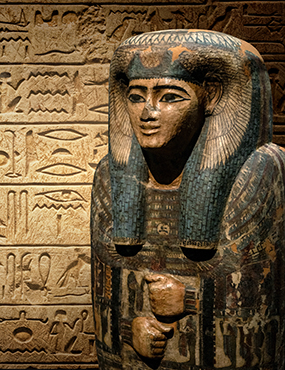
Reframing who decides treatment of the dead
Ancient Egyptian mummified human remains are displayed in museums around the world, studied by researchers and viewed by millions of visitors. Yet until recently, the voices of Egyptians themselves were largely absent from decisions about how their ancestors should be cared for, interpreted and displayed – if at all.
Macquarie University’s Professor Ronika Power and Jacinta Carruthers – together with Dr Melanie Pitkin from the University of Sydney and Professor Alice Stevenson from University College London – lead the world’s first research program to develop culturally specific, community-centred approaches to the stewardship of ancient Egyptian human remains: The Human Remains Research Project.
Centring Egyptian perspectives
The Human Remains Research Project began when a British Museum exhibition premiered in Sydney in 2016–17 and has since grown into an internationally recognised program reshaping museum practice.
The research asked:
- how Egyptians – both in Egypt and across the global diaspora – believe their ancestral remains should be studied, displayed and cared for
- how museums can move beyond colonial models of collecting and interpretation.
Drawing on surveys, focus groups and, most significantly, the first ethics roundtable discussions ever held in Egypt on the issue, the project has brought together more than 70 leaders from Egypt’s museum, heritage, archaeology, education and media sectors in partnership with the Egyptian Ministry of Tourism and Antiquities.
For the first time, robust evidence of Egyptian perspectives was assembled to guide decision-making.
Changing museum practices around the world
The research has already delivered significant international impact, directly informing the redesign of a Sydney museum gallery and the removal of mummified human body parts from public display – a landmark decision that prompted global discussion about the treatment of ancestral remains.
The project also produced the world’s first Guidelines for the Care of Ancient Egyptian Mummified Human Remains (2024), followed by the Chau Chak Wing Museum Guidelines for Ancient Human Remains (2025).
These practical frameworks are helping museums adopt culturally informed, community-led approaches to the care and interpretation of ancient Egyptian remains.
The research is informing museum policy and professional practice in Australia, Egypt and internationally, supporting ethical standards aligned with:
- the United Nations Declaration on the Rights of Indigenous Peoples
- the Vermillion Accord on Human Remains
- the Tāmaki Makaurau Accord on the Display of Human Remains and Sacred Objects.
Continuing the conversation
By demonstrating that ethical stewardship must prioritise the perspectives of people whose ancestors are on display, the Human Remains Research Project is transforming how museums around the world understand, interpret and care for the ancient dead.
The project is expanding its international influence through:
- new community consultations across Egypt
- partnerships with the International Council of Museums (ICOM) Egypt
- the development of co-designed approaches that place descent communities at the centre of decisions about their cultural heritage.