Protecting patients while enabling surgical innovation
In 2007, the death of a young patient during an experimental surgery in the UK exposed a critical gap: there was no reliable way to identify when a surgeon was doing something new, so no trigger for safeguards to protect patients.
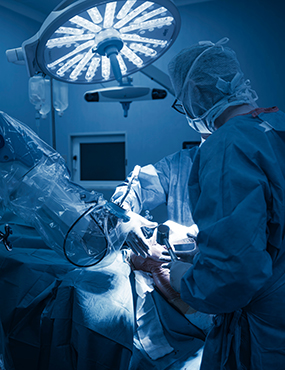
Mitigating the risks of innovation
Surgical innovation, including keyhole surgery and life-changing implants, has transformed healthcare. But, unlike new medicines, new surgical techniques can be introduced with little formal oversight or evaluation. The consequences can be devastating.
Distinguished Professor Wendy Rogers and colleagues at Macquarie University set out to change that.
Defining surgical innovation
In 2010, Professor Rogers assembled a multidisciplinary team of ethicists, philosophers, legal scholars and surgeons to answer a deceptively simple question: what counts as surgical innovation?
Supported by an Australian Research Council Linkage Project and six partner organisations, including the Royal Australasian College of Surgeons, the team developed the first practical framework for identifying different forms of surgical innovation.
They demonstrated that innovation extends beyond entirely new procedures to include:
- new applications
- new patient groups
- new settings
- techniques that are new to individual surgeons.
Each type carries different ethical and clinical risks.
Building on this work, the researchers created the Macquarie Surgical Innovation Identification Tool (MSIIT). This tool enables hospitals and surgeons to recognise innovation before it occurs so that appropriate governance, ethical oversight and patient protections can be put in place.
Influencing practice around the world
The Macquarie team’s research has reshaped surgical policy and practice internationally: The Royal College of Surgeons (UK) incorporated the MSIIT into its national guidance Surgical Innovation, New Techniques and Technologies: A Guide to Good Practice (2019).
The framework has since informed international guidelines developed by the European Glaucoma Society and global experts in robotic surgery. The research also helped shape the internationally recognised IDEAL Framework for evaluating surgical innovation.
Professor Rogers became a co-author of the landmark 2019 framework, while Dr Katrina Hutchison now chairs the ethics working group for an international collaboration evaluating surgical robotics. Both researchers also contribute to the Declaration of Sydney Taskforce on the Ethical Use of AI in Neurosurgery.
The MSIIT has been successfully piloted in Australian hospitals, including Macquarie University Hospital, Westmead Hospital and the Queen Elizabeth Hospital in Adelaide, demonstrating its value in real clinical settings.
Shaping the future of surgery
The research has established Macquarie University as an international leader in:
- the ethics of surgical innovation
- informing new work on artificial intelligence
- surgical robotics
- medical devices
- emerging health technologies.
As innovation accelerates, Professor Rogers and her colleagues continue to ensure that patient safety keeps pace. Their work has demonstrated that ethical governance and clinical innovation are not competing priorities but essential partners in delivering safer, more effective healthcare worldwide.