To celebrate the Lunar New Year the Gale History Museum has installed a display showcasing representations of horses in our collection.
Dr Mei-fen Kuo, Lecturer in Contemporary Chinese Culture and History in the School of International Studies has contextualised our display with an exploration of the significance of the horse to the 19th C Chinese Diaspora in Australia. The text was translated into Chinese by her student Ruth Shillabeer. Download the simplified Chinese translation.
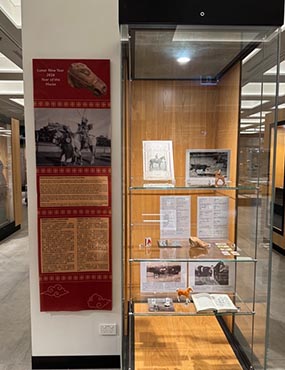
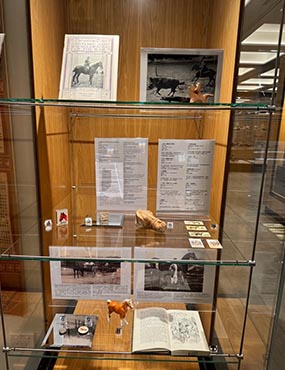
Horse and Chinese Immigrants in Historical New South Wales
Dr Mei-fen Kuo, Lecturer in Contemporary Chinese Culture and History, School of International Studies
In Chinese culture, horses are commonly regarded as symbols of diligence, aspiration, and success. The history of Chinese immigrants in New South Wales reflects these cultural meanings in everyday life and social practice.
Before the arrival of the motor car, horses played a central role in the working and social lives of Chinese immigrants in New South Wales. In rural areas, horses supported market gardening and enhanced women’s mobility, allowing families to travel, trade, and maintain social networks across dispersed communities. Prominent Chinese merchants were often closely associated with their horses. For example, Quong Tart was frequently photographed with his horse Nobby, symbolising respectability, mobility, and social belonging. Similarly, Chinese merchant Harry Fay in Inverell established the Fay Cup, reflecting the integration of Chinese Australians into local equestrian culture.
In urban settings, horses also accompanied Chinese communities during public events and civic celebrations. Chinese processions featuring horses formed part of major public occasions, such as the Queen Victoria Diamond Jubilee celebrations in Sydney in 1897, through which Chinese Australians negotiated their visibility and social position within colonial society.
Together, these examples show that horses were not merely practical tools but also symbols of social status, community presence, and civic engagement for Chinese Australians in nineteenth-century New South Wales.
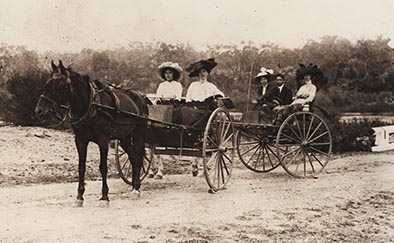
Maud and Dolly Nomchong with Sydney friends by the Bombay Bridge on the Shoalhaven River, Braidwood (c.1910–1914), capture a moment of leisure and sociability that reveals the everyday belonging of Chinese Australian families in regional New South Wales beyond the goldfields era. Daughters of the Nomchong family, they belonged to a generation of Chinese Australian families who were establishing permanent, locally rooted lives—unlike the stereotypical image of Chinese migrants as transient male sojourners. Courtesy Braidwood & District Historical Society.
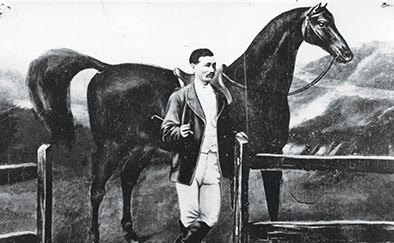 Quong Tart arrived in Australia at the age of nine and first lived in Braidwood. Later becoming a merchant and philanthropist in Sydney, his photograph with his horse Nobby in the 1870s traces a life path from regional settlement to public presence.
Courtesy Braidwood & District Historical Society.