United towards ‘the glad tomorrow’
Macquarie paid tribute to the resilience of First Nations Peoples and urged our community to take action towards a more equitable and hopeful future.
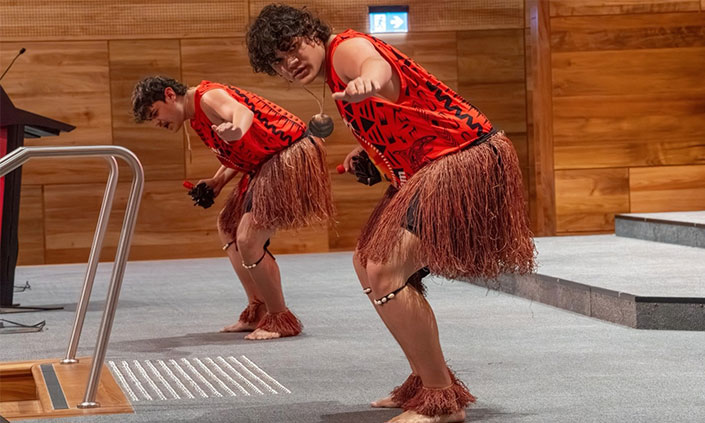
During Macquarie’s All In event, a panel of Indigenous thought leaders and allies shared their unique stories and insights and called on the community to:
- listen with humility
- develop compatibility despite conflicting opinions
- treat reconciliation as everyone’s responsibility.
A performance by Mui Mui Bumer Gedlam Dance Group also provided a moving testament to the intergenerational preservation of culture, identity and storytelling through song, dance and symbolism.
Honouring language and Country
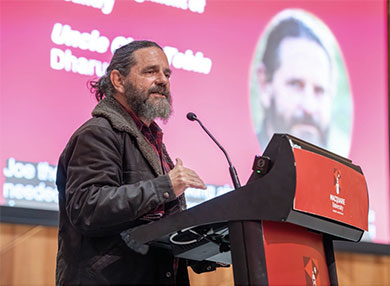 Dharug Uncle Chris Tobin delivered the Acknowledgement of Country, recognising the importance of acknowledging Aboriginal Countries. It is an important way of respectful truth-telling, he said and keeping our ancient responsibilities as good managers of Country firmly in our collective consciousness.
Uncle Chris meditated on a brighter future for the generations to come as we develop more connected and responsible relationships with the Aboriginal Countries we live on.
Opening the event, Macquarie President and Vice-Chancellor Professor S Bruce Dowton advocated for reconciliation as a long-term journey that embraces mutual respect and dialogue.
“We need dialogue and deeper understanding in place of divisive debates,” he said.
“Reconciliation is about making conflicting ideas compatible – through discussion and discourse rather than debate, which implies winners and losers.”
Professor Dowton also quoted A Song of Hope by Aboriginal poet and activist Oodgeroo Noonuccal, in reference to the ongoing resilience of Indigenous communities, and the promise of reconciliation that drives them:
To our fathers’ fathers / The pain, the sorrow
To our children’s children / The glad tomorrow
A movement, not a moment
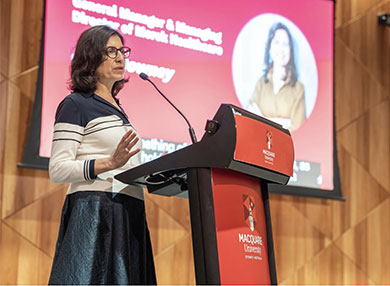
Josie Downey, Managing Director of Merck Healthcare, reflected on corporate Australia’s role, highlighting Merck’s partnership with Macquarie to:
- introduce STEMM career pathways
- provide funding for multi-year Indigenous STEMM scholarships.
“We believe that increasing Indigenous representation in STEMM not only benefits students but strengthens science, healthcare, Australia and our future,” she said. Ms Downey also spoke of the value of Reconciliation Action Plans (RAPs) to provide structure and momentum where goodwill is not enough.
“Understanding the history, the culture and the lived experience of First Nations peoples is not optional for those of us in positions of influence – it is foundational,” she said.
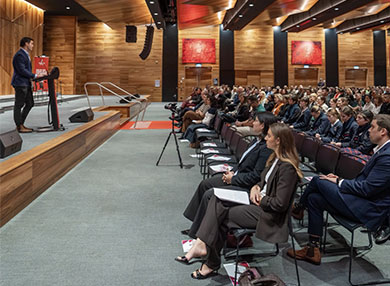 Macquarie alum Edward Morgan, CEO and co-founder of Bandu, delivered a non-Indigenous perspective on the role of allies in advancing reconciliation.
“Cultural safety occurs when First Nations people are at the heart of processes we create – not as a symbolic gesture but as a genuine commitment to equity,” he said.
Bandu is a majority First Nations-led social enterprise and charity, dedicated to closing gaps in education and employment opportunities for Aboriginal and Torres Strait Islander students. In his speech, Morgan focused on the importance of cultural safety and intentional action in advancing reconciliation.
Emphasising the significance of visible symbols, Morgan told the story of a young job seeker who felt immediate comfort upon seeing Indigenous artwork behind the reception desk. “People say these gestures are performative, but if they make even one person feel safe, then they’re worth it,” Mr Morgan reflected.
“Despite every effort to break connection, it persists”
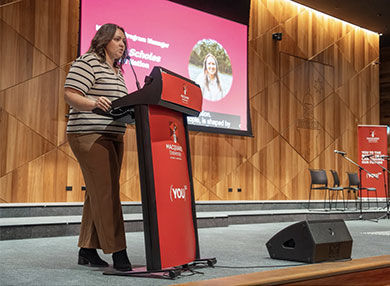 Alanah Scholes, a proud Gamilaroi woman and a RAP program manager for the National Rugby League (NRL), shared perspectives shaped by her lived experiences as a fourth-generation descendant of Stolen Generations survivors.
Ms Scholes recounted the story of her great-grandmother and her siblings, who were forcefully taken to homes far from their land. This “legacy of disconnection, loss of language and identity,” she explained, continues to shape her worldview.
She also highlighted the enduring strength and resilience of Indigenous cultures, describing how her family’s survival and reclamation of what was taken is what fuels her.
“Despite every effort to break connection, it persists,” she shared. “We can only move forward when Aboriginal and Torres Strait Islander voices are heard and valued not just in moments of visibility but across all sectors of Australian society.”
Ms Scholes also highlighted the unique role of sport, noting its power to:
- unite communities
- shift national conversations
- elevate Indigenous excellence.
At the NRL, she said, cultural pride is celebrated through storytelling and symbolism embedded into the game, from jerseys worn with Aboriginal designs to initiatives that foster Indigenous leadership.
United in aspiration yet sobered by the challenges ahead, Professor Dowton’s closing words resonated profoundly with participants and panelists alike.
“Hope is not a strategy. But combined with action, it becomes transformative.”
Contact Alumni Relations
Level 2 East, 18 Wally’s Walk
Macquarie University
Wallumattagal Campus NSW 2109