Leading the regenerative revolution
Alumni Reconnect 2026 brought MQ graduates and star researchers for a day of reunion, big ideas and honest discourse on our relationship with nature.
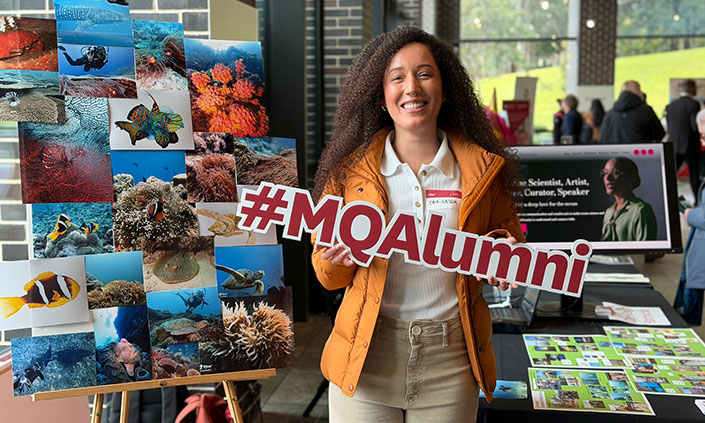
This year’s theme, ‘Nature-positive pathways toward a sustainable future’, provided our alumni community the warmth of a reconnection with their alma mater, blended with authentic knowledge exchange and access to some of Macquarie’s innovative research, expert minds and community leaders.
The event showcased the Australian Harmony Centre for Ecosystem Futures, which brings together researchers, Indigenous leaders, communities and industry with the shared goal of achieving harmony between nature and people. Named in honour of His Majesty King Charles III’s book, Harmony, which describes is philosophy and approach to sustainability, the Centre spans all four of the University’s faculties, from environmental science and ecology to business, Indigenous studies and human health.
The day opened with a smoking ceremony led by Dharug elder Aunty Leanne King, followed by an Acknowledgement of Country from MC Natasha Balsdon, a Gamilaraay woman, Indigenous Student Engagement Officer and Macquarie alumna.
“This campus holds memories,” said Balsdon. “It’s where we found lifelong friendships, discovered our passions, overcame challenges, celebrated achievements and for many of us, found a sense of belonging.”
Coming together on the day, whether joining online or in-person, the event posed one simple question to our community: Why should we care about nature?
Someone always pays the price
Keynote speaker Dr Nathan Ross MVO, Director of the Sustainable Markets Initiative and former climate change advisor to King Charles, first posed the question, ‘why should we care about nature?’ and laid out why the stakes are so high.
“We live as if we’re separate from Nature, but when it’s damaged and out of balance, someone, somewhere, at some point in time pays the price. If someone catches all the fish upstream, someone downstream goes without.”
He also cautioned that, if humankind remains on its current trajectory, we will see “enormous human consequences”, some of which are already playing out despite years of warnings from scientists and conservationists. “For several decades, people have been saying, “We need to save the environment for future generations.” Well, now we are that future generation,” he said.
In closing, Dr Ross laid out five key actions humankind must take to address the critical issues, which he described as a monumental, but essential undertaking:
- stop making the situation worse and direct greater investment into people and technologies to advance renewables and decarbonisation efforts
- actively restore nature by investing in repair and restoration of critical environments
- prepare mankind for the now unavoidable natural disasters resulting from climate change
- educate all Australians about these issues and the true impact of policy and economic reforms
- champion the scale and speed of action on an international scale.
Putting nature back at the centre
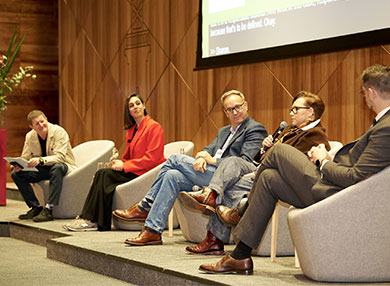
Moderated by Centre Director Professor Peter Davies, the panel drew together strikingly different perspectives, which made for an engaging session of discussion and debate.
Sharon Winsor, a Ngemba Weilwan woman, alumna and founder of Indigiearth, described the nature-based knowledge readily available to us, such as reading country through its plants. “The plants tell us stories, the flowering, whether the plant’s healthy, whether the water’s healthy,” she said. “They all share stories and they tell us what’s happening on country.”
On the flip side, Dr Vanessa Pirotta, global marine wildlife expert, alumna and lecturer who completed her Masters and PhD at Macquarie, spoke about building connection to what we cannot see. “People need to know that everyone has a connection to nature,” she said.
As an example, Pirotta shared that humpback whales born around Sydney this year “will persist for 80 plus years,” serving as a reminder that today’s choices ripple across generations of natural wonders.
Lifelong unlearning and relearning
Dermot O’Gorman, CEO of WWF-Australia, made the case for rethinking how we live and work. “How do we learn, unlearn and relearn how to live on this planet in a harmonious way?” he asked, arguing for “the first regenerative revolution, rather than another industrial revolution.”
During question time, one alumna who studied applied finance and later environmental science at Macquarie, described a quarry affecting her small Central Coast community and its endangered swift parrots and green and golden bell frogs.
She said, addressing the panel: “We’re such a small community against a quarry that has a lot of money behind them. What can we do?”
Panelists offered practical pathways, from engaging local government and parliamentarians to connecting with the local land council and community networks.
One idea to spark wave of progress
While Ross’ keynote and the ensuring panel discussion was humbling, the lasting message was ultimately hopeful and encouraging – rather than freeze in the face of the whole challenge, we should break it down “piece by piece”, to identify small ways so we can all help make the future safer.
Closing the day, Executive Director of Philanthropy and Alumni Relations Hedda-Katrin Paisley, a Wiradjuri woman, offered a simple invitation:
“Take one idea, one connection, or one source of inspiration from today and turn it into an action.”
Guests documented their one idea on postcards provided, as a reminder of where they can make a positive difference.
Following the panel, guests were invited to tour interactive research showcases from the Harmony Centre hosted by researchers, alumni and professional staff. Short talks and campus tours highlighted the value of bringing interdisciplinary perspectives together, while demonstrating practical work underway to restore nature and care for Country on the Wallumattagal Campus.
Contact Alumni Relations
Level 2 East, 18 Wally’s Walk
Macquarie University
Wallumattagal Campus NSW 2109