Contact us
The Australian Centre for Egyptology
Level 1, Building B, 25 Wally's Walk
Macquarie University
Current research projects
The Australian Centre for Egyptology supports fieldwork at important sites across Egypt and the research projects of its members. Learn more about the work currently conducted by these teams.
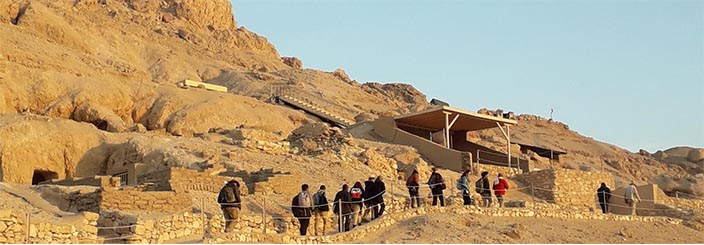
Key research topics include:
- understanding ancient Egyptian people and society through fieldwork on selected archaeological sites in Egypt
- networks of ancient trade and the role of Egypt in the eastern Mediterranean
- the history of exploration and museum collections through studies of modern archives
- research on the languages of ancient Egypt, including hieroglyphs, Greek and Coptic
- life and death in ancient Egypt through the study of its material culture, burial practices and the use of science.
Archaeology
Funded by: Australian Research Council Future Fellowship 'Rescuing Pharaoh's Gold Mines: Archaeological conservation in Eastern Sudan' (FT230100067)
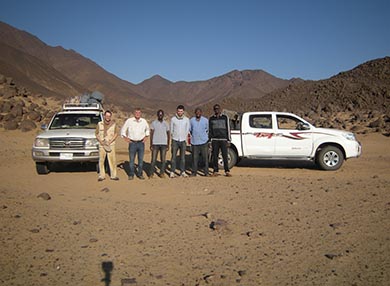 The Atbai survey project is a collaborative project that aims to survey and map the archaeology of the east Nubian deserts (southern Egypt/northern Sudan), the 'Atbai' in the indigenous Beja language.
This vast desert landscape is characterised by goldmines, nomadic camps, rock art panels and extensive tumulus cemeteries. The region was home to various groups such as the Medjay, Blemmyes and Beja of historical records.
Successive Nile regimes from Pharaonic, Ptolemaic, Roman and Arab Egypt as well as Kushite and Medieval Nubian kingdoms, traversed this desert in search of gold and Red Sea trade routes, creating complex and enduring relationships between local nomads and urban kingdoms.
Owing to the rugged terrain and logistical difficulties, many Atbai sites are undocumented and face significant heritage threats from gold-mining and other development. The project combines various workflows from remote sensing, ground-surveying, community engagement and scientific analysis to raise
scientific and public awareness of this important and historic landscape, creating new stories of nomads, gold extraction and heritage protection in Northeast Africa.
Lead researcher: Dr Julien Cooper
Funded by: Macquarie University Research Seeding Grant (2019–22)
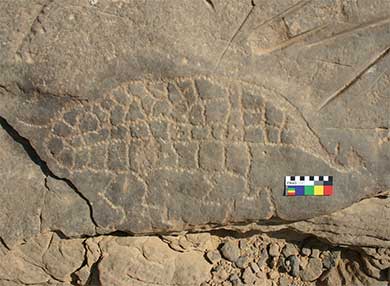 We are investigating El-Hosh, one of the most extensive Nilotic rock art sites in Upper Egypt. The petroglyphs at El-Hosh include a dazzling array of boats, wild animals and enigmatic abstract signs scattered over a wide area.
Recording and interpretation of this rich artistic medium is providing new insights into the early history and cultural development of Nilotic communities, significantly increasing our knowledge of the Egyptian Palaeolithic, Epipalaeolithic and Predynastic horizons (c. 13000–3000 BC), for which documentary
evidence is still fragmentary.
Research team
- Dr Linda Evans
- Wouter Claes (Royal Museums of Art and History, Brussels)
- Dr Fred Hardtke
Funded by: Australian Research Council Grant DP220102637, Macquarie University Research Grants and the Rundle Foundation for Egyptian Archaeology
Work in the important site of Beni Hassan has been conducted by a number of scholars, the last of whom was Newberry, whose publications of the decorated tombs (1890-1894) remained, until recently, the most widely used. The unusually decorated burial chamber of Baquet ll has been published.
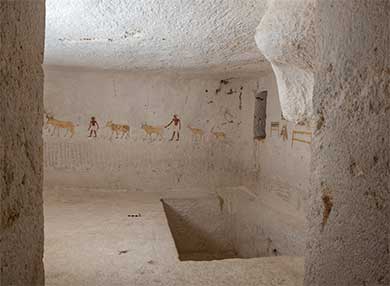 The current project, which started in 2010, is still in progress. It aims at re-excavating, recording and publishing the decorated tombs and a selected number of the undecorated ones, which exhibit important architectural features. In addition to full commentaries, the planned publications include architectural drawings, line drawings of wall scenes and inscriptions and coloured photographs.
These tombs show magnificent architectural plans, some with spectacular porticos and pillared chapels. The wall scenes, which have retained a great deal of their colours, depict many daily life activities as well as important events in the lives of the owners.
The re-clearance of the burial shafts were most surprising, occasionally revealing large burial apartment, with skeletal remains, funerary objects and wall paintings showing animate figures of humans and animals.
In addition to two decorated Old Kingdom tombs, work has been completed in the tombs of Amenemhat, Khnumhotep I, Khnumhotep II, Baqet III, and Khety,
Work is currently in progress in the tombs of Remushenti, Baqet I and Baqet II, as well as the undecorated tombs Nos 18 and 32.
Research team
Lead researchers:
Collaborators:
- Zeinab Hashesh (Beni Suef University)
- Eman Khalifa (Cairo University
- Michael Schultz (Göttingen University)
- Ashraf Senussi (MOTA)
- Sameh Shafik (Higher Institute for Tourism and Hotel Management, Luxor)
- Ahmad Soleiman
- Naguib Victor
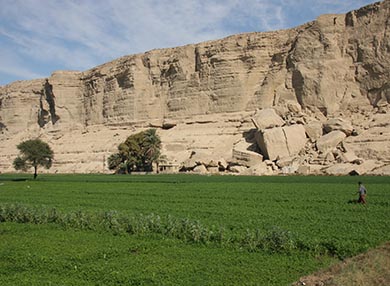 The Macquarie University Tehnā project works at Tehnā al-Ǧabal (Akoris) in Middle Egypt, a significant provincial site continuously inhabited from the late Old Kingdom through the seventh century CE.
The project consolidates and finalises results from unpublished archaeological work at the site: Dr Elizabeth Thompson’s expeditions (2007–2011) and Dr Farouk Gomaà (1995).
The project is focusing initially on the late Old Kingdom cemetery, verifying epigraphic drawings and measurements, and publishing Thompson’s manuscript The Old Kingdom Cemetery at Tehna Vol. 2.
The project is also integrating Gomaá’s photographs, site plans, and epigraphic notes, which were given to Macquarie University in 2025 and which provide critical comparative data for these poorly preserved tombs.
Research team
- Julia Hamilton
- Kim McCorquodale
Funded by: Shelby White and Leon Levy Program for Archaeological Publications Grant (Harvard University)
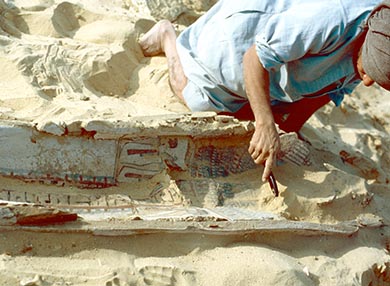 The project aims to publish a cemetery of ordinary Egyptians found during archaeological excavations at Saqqara. In 1996, the Australian Centre for Egyptology, under the direction of Professor Naguib Kanawati, found a large cemetery of modest burials in a small area near the pyramid of 6th Dynasty king Teti (c. 2345-2323 BC).
The variety of burial types and the many human remains represent a snapshot of the local ancient Memphite population. While such cemeteries are known elsewhere at Saqqara, even now, very few such burials have been published.
Relative to tombs of the elite, the burials of ordinary Egyptians receive meagre treatment in the archaeological literature. There are many reasons for this:
- absence of inscriptions
- poor preservation
- research priorities
- incidental discovery in the quest for other remains.
Publication of the excavations will bring to light this unique discovery, which includes many remains dating to the mid-18th Dynasty (c. 1400 BC).
Chief investigator: Dr Karin Sowada
Research assistant: Dr Ellen Ryan
Full title: Revealing the ancient Nile and its connections to archaeological sites and regional centres of power
Funded by: US National Science Foundation (NSF), The Explorers Club
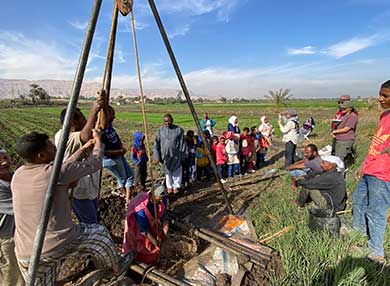 Associate Professor Tim Ralph is part of an interdisciplinary team using remote sensing, geomorphology, geophysics, sediment analysis and dating, and archaeology to tell the story of the ancient Nile, its relevance for the Egyptian pyramid chain and other archaeological sites, and its role connecting regional centres of power.
The goals are to help describe how the ancient Egyptian people adapted to the ebb and flow of the river, locating settlements and monuments according to its position the floodplain, and to assist finding and conserving ‘lost’ sites of cultural and archaeological significance.
Recent findings published in Communications Earth & Environment confirmed the presence of an extensive ancient branch of the Nile River, the Ahramat Branch, extending for more than 60 km and past 31 pyramids along the Western Desert margin of the
Nile floodplain between Lisht and Giza.
Many of the pyramids had causeways leading to the branch, where valley temples may acted as river docks in the past. Other pyramids were connected to inlets associated with the Ahramat Branch on the edge of the desert, suggesting higher water levels and that the branch was active during multiple phases
of pyramid construction.
Lead researcher: Associate Professor Tim Ralph
Funded by: Macquarie University Gale Fund, Australian Research Council, Macquarie University Research Development Grants, Rundle Foundation for Egyptian Archaeology
The ongoing Macquarie Theban Tombs project has been working in four New Kingdom tombs located in Dra Abu el-Naga at the northern end of the Theban necropolis since 1991. These are:
- TT 148 (3rd Priest of Amun, Amenemope, Dynasty 20)
- TT 233 (Royal Scribes Saroy and Amenhotep/Huy, Dynasty 19)
- TT 147 (Scribe and Cattle Counter Neferrenpet, Dynasty 18)
- TT 149 (Royal Scribe Amenmose, Dynasty 20).
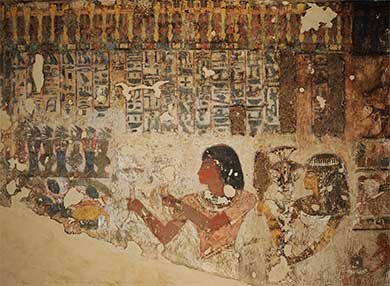 Apart from TT 148, very little was known of these poorly preserved tombs and their owners, and the project has succeeded in retrieving and recording significant new epigraphic and archaeological data that illuminate:
- the family backgrounds and careers of the owners
- their role in the administration of their times
- funerary beliefs and practices.
Reconstructing the history of the use of the tombs has also been a focus, including their systemic reuse as burial sites from Dynasties 21 to 26, and in particular their non-systemic use as dwellings in the Late Antique/Coptic Period when TT 233 and TT 147 were part of the earliest phase of a monastic complex that developed into the nearby monastery of St Paul at Deir el Bakhit.
Research team
Co-Directors:
Collaborators:
- Dr Thomas Bekh
- Dr Susanne Binder
- Professor Malcolm Choat
- Dr Camilla Di Biase-Dyson
- Dr Mary Hartley
- Dr Kim McCorquodale
Egyptian language
See our team's current Egyptian language projects.
This project takes a deep dive into how we can trace ancient thought-processes based on ancient Egyptian data.
Drawing on evidence from texts, images and objects, manuscripts and spaces, this project charts new territory by drawing on the insights that cognitive science, metaphor studies, semiotics and archaeological theory can bring to our conceptualisation of ancient ways of thinking.
Text-based studies involve studies of metaphor and metonymy, as well as ontologies. Visual studies explore what is chosen to be depicted in a given image or object. Manuscript analyses consider the steps taken (via handwriting, spelling and style) to compose the text and spatial studies engage with the creation and alteration of the built and natural environment.
Lead researcher: Dr Camilla Di Biase-Dyson
History
See our team's current history research projects.
When Egypt was at the height of its power among the kingdoms of the Hellenistic world, Ptolemy III Euergetes (the Benefactor) in 246 BCE inherited the throne from his father Ptolemy II Philadelphus (the sister-lover).
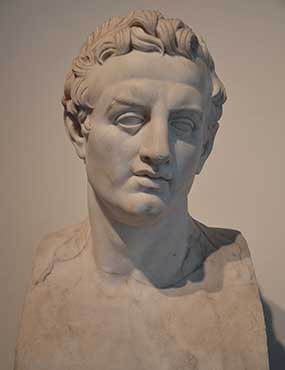 There is as yet no monograph devoted to the complex achievement of Egypt during his reign. Paul McKechnie will write this book, examining Euergetes’ twenty five years in power:
- the world-shaking invasion of Syria and Mesopotamia
- Euergetes’ wealth and his immense palace in Alexandria (an Egyptian Versailles)
- the highest achievements of Greek science
- Euergetes’ alignment with Egyptian priests, and his temple-building.
Euergetes married his half-cousin Berenice – a marriage which reunited Cyrenaica and the Ptolemaic kingdom. Berenice features on a gold coin. Euergetes did not issue coins with his own image, but his face is known from this bust in Naples National Archaeological Museaum. (Photograph by Carole Raddato).
This project has not received funding.
Animals were an integral part of Egyptian life. Knowing about the creatures with which they interacted can therefore tell us much about the Egyptians’ lived experience and often explains why some species were valued more than others.
My current research, in collaboration with Philip Weinstein (University of Adelaide), examines the impact that invertebrates (insects, arachnids, crustaceans, etc.) had on Egyptian culture, from their role in art and religion to their effect on the health and wellbeing of the population.
The aim of the project is to highlight the importance of these much-maligned animals, not only for Egyptian society but also in the modern world, where invertebrates are often the last creatures to be considered when evaluating the effects of species extinction and environmental change.
Lead researcher: Associate Professor Linda Evans
Art history, museums and archives
See our team's current art history, museum and archives research projects.
Funded by: Australian Research Council Grant DP220102637
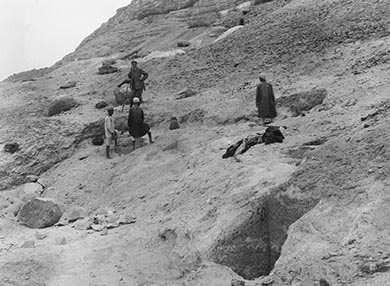 This project has been undertaken as a postdoctoral fellowship within Professor Naguib Kanawati’s ongoing Beni Hasan research program. Its main objective is to analyse the site’s lower cemetery, reconstruct its tomb groups and assess the broader archaeological context through the study of museum collections and archival records.
Excavated by John Garstang between 1902 and 1904, the area revealed around 900 tombs and hundreds of artefacts now dispersed across museums worldwide.
The research has involved extensive work in archives and museum collections. A key stage took place at the Garstang Archive, University of Liverpool, which preserves correspondence, photographs, and glass‑plate negatives documenting the excavation and distribution of finds.
This study identified 114 institutions holding Beni Hasan material. Fieldwork in major collections – including the Garstang, Manchester, Fitzwilliam and Cairo museums – has already led to the documentation of over 2,000 artefacts, many inscribed with their original tomb numbers. This work contributes to a deeper understanding of the Beni Hasan cemetery and provides valuable insights into funerary customs within Middle Kingdom regional traditions.
Lead researcher: Dr Marisol Solchaga